9 Facts About Florence Nightingale They Forgot to Teach You in Nursing School

📜 THE FORGOTTEN SCROLLS: Chronology of the Night Watch
SCROLL SIX: 9 FACTS ABOUT FLORENCE NIGHTINGALE THEY FORGOT TO TEACH YOU IN NURSING SCHOOL
Turns out the “Lady with the Lamp” was basically the original, caffeine-fueled night-shift warrior who had absolutely zero patience for bad administration.
If you survived nursing school in Ireland or anywhere else in the Western world, you’ve had the name Florence Nightingale roughly four million times.
She is universally remembered as the sweet Victorian lady with the lamp, floating through dark corridors in a white cap and bringing comfort to wounded soldiers.
But let’s be honest:
That version is far too tidy.
Florence Nightingale was a statistician, hospital reformer, writer, administrator and relentless campaigner for better healthcare. She used data to challenge military and government assumptions, fought for sanitation and better hospital design, and helped establish professional nurse training.
If she were alive today, I have a strong suspicion she would have opinions about hospital management.
And probably spreadsheets.
Here are nine facts about the real historical commander of our coven that deserve a place outside the usual Lady with the Lamp story.
1. SHE DIDN’T JUST “HOLD” A LAMP — SHE WALKED THE NIGHT WARDS
Textbooks love the romantic image of Florence carrying her little lamp.
And yes, the image has a historical basis.
During the Crimean War, Nightingale became associated with visiting wounded soldiers at night, earning the nickname “The Lady with the Lamp.” The National Army Museum records her night visits, while the Florence Nightingale Museum still preserves the lamp associated with her Crimean service.
But she wasn’t simply wandering through the corridors looking poetic.
She was leading a team of nurses in the enormous military hospital complex at Scutari, dealing with overcrowding, poor sanitation, inadequate supplies and appalling conditions.
In other words:
She was working nights in a hospital where the phrase “staffing issue” probably didn’t begin to cover it.
The romantic lamp survived.
The administrative nightmare mostly disappeared from the schoolbook version.
Funny how that works.
2. SHE TURNED STATISTICS INTO A WEAPON
You might think charting at 4 AM is a modern form of corporate torture.
You actually have Florence to thank for some of the foundations of what we now recognize as healthcare data visualization.
Nightingale was a pioneering statistician and became the first woman elected to the Royal Statistical Society in 1859. She used statistical analysis and striking visual diagrams to communicate mortality data and argue for sanitary reform.
Her famous polar-area diagrams, sometimes called coxcombs, made the scale and causes of military mortality visually difficult to ignore.
And this is where the story gets particularly satisfying.
The data showed that disease and preventable conditions were responsible for far more deaths than battle wounds during significant periods of the Crimean War.
She didn’t invent the concept of a pie chart.
But she became one of the great pioneers of using statistical graphics to make governments actually look at what the numbers were saying.
She didn’t trust the rumors.
She brought receipts.
Every nurse who has ever said, “Show me the numbers,” is spiritually standing behind her.
3. SHE HAD A PET OWL
Now we arrive at the part that makes the entire The Owl Nurse mythology look suspiciously well planned.
Florence Nightingale rescued a little owl while she was in Greece.
She named her Athena.
And according to the Florence Nightingale Museum, Athena became Florence’s companion and was carried around in a specially made pouch. The owl was eventually preserved and remains part of the museum’s collection.
So yes.
Florence Nightingale, one of the most famous figures in nursing history, actually had a pet owl.
Imagine the scene.
Victorian Florence:
“I have statistical reforms to complete.”
Athena:
“Hoo.”
Florence:
“Exactly.”
It is the ultimate night-shift aesthetic.
A nocturnal creature.
A woman who preferred working when everyone else was asleep.
And an owl.
I rest my case.
4. SHE REJECTED MARRIAGE BECAUSE SHE WANTED A DIFFERENT LIFE
Florence was born into a wealthy Victorian family where marriage and domestic life were very much part of the expected path for a woman of her social position.
She did receive marriage proposals.
One of the best-known was from Richard Monckton Milnes, a wealthy and well-connected politician and poet who pursued her for years.
In 1849, Nightingale declined his proposal.
Her surviving writings show that she saw marriage and conventional domestic life as potentially incompatible with the work she believed she was called to do.
That doesn’t mean she simply woke up one morning and shouted:
“NO HUSBAND. ONLY NURSING.”
History is rarely that tidy.
But she did make an extraordinary choice for her time.
She wanted an independent intellectual and working life.
And eventually, she got one.
A Victorian woman choosing statistics, hospitals, public health and reform over a comfortable social life?
That’s not exactly the behavior of the delicate little lady from the textbook illustration.
5. SHE HELPED CHANGE THE WAY HOSPITAL WARDS WERE DESIGNED
This one is particularly relevant to anyone who has ever worked a hospital corridor at 3 AM.
Nightingale became a major advocate of the pavilion-style ward.
These wards were typically long, rectangular spaces with large windows designed to maximize light and ventilation, with arrangements that also supported nursing supervision. The Florence Nightingale Museum describes the Nightingale ward as an oblong room with windows on both sides and two lines of beds.
She was very interested in:
- ventilation,
- cleanliness,
- light,
- ward layout,
- efficient nursing,
- supervision,
- and the relationship between architecture and patient care.
Her recommendations included specific numbers of patients and generous space and ventilation requirements. Some of her writings preferred wards of around 20–32 patients, while other discussions of her work cite her preference for larger units of around 40 where they could be efficiently supervised.
So I am removing one dramatic claim from the original:
She did not invent the entire modern hospital ward from nothing.
The pavilion principle had earlier architectural precedents.
What she did was help popularize, refine and rigorously argue for a particular approach to hospital design, especially around ventilation, space and nursing supervision.
In other words:
She didn’t invent the hospital.
She just had some extremely strong opinions about how it should work.
Which, frankly, is very nurse of her.
6. SHE FOUGHT OVER FOOD, SUPPLIES AND THE BASIC BUSINESS OF KEEPING PEOPLE ALIVE
Long before modern nurses were surviving on break-room toast and whatever suspicious substance has been sitting in the staff fridge since Tuesday, Florence was dealing with the practical realities of feeding sick people.
At Scutari, she used her influence and personal funds to obtain food, supplies and other necessities when the military system was failing to provide adequately. Historical accounts describe her purchasing fruit, vegetables and hospital equipment and helping improve the hospital’s food and sanitary arrangements.
She understood something that every night nurse eventually learns:
You cannot build a functioning healthcare system around people who are hungry, exhausted and working without the basic resources they need.
There is no mystical clinical intervention that fixes an empty kitchen.
Sometimes the revolution begins with:
“Where the hell is the food?”
7. 2020 WAS FLORENCE NIGHTINGALE’S 200TH BIRTHDAY — AND THE WORLD DECIDED TO CELEBRATE WITH A PANDEMIC
This is one of those historical coincidences that would be funny if 2020 hadn’t happened.
The World Health Assembly designated 2020 as the International Year of the Nurse and the Midwife, deliberately connecting the year with the 200th anniversary of Florence Nightingale’s birth.
And then COVID-19 arrived.
Instead of a peaceful year of elegant historical celebrations, nurses around the world found themselves working through one of the most extraordinary healthcare crises in modern history.
The universe has a very dark sense of humor.
Florence Nightingale’s bicentenary arrived with:
PPE.
12-hour shifts.
Staff shortages.
Exhaustion.
And absolutely no respect whatsoever for the concept of a commemorative calendar.
If Florence had been watching from somewhere in the shadows, I suspect she would have been less interested in the speeches and more interested in the data.
She always was.
8. SHE DIDN’T BECOME A TRAINED NURSE AT 18
If you entered nursing later in life as a mature student, Florence Nightingale is a particularly useful reminder that professional purpose does not come with an expiry date.
She spent years fighting against her family’s expectations before pursuing formal nursing training.
She had already experienced hospitals and nursing institutions in Europe before undertaking training at Kaiserswerth in Germany in 1851. She was 31 years old.
She was 34 when she went to the Crimea in 1854.
So if you started nursing later than your friends, changed careers, returned to education or simply took longer to figure out what you wanted to do with your life:
Congratulations. Florence was not exactly an 18-year-old fresh out of school either.
Some people need more time.
Some people need more life behind them before they understand what they are actually here to do.
And some of us apparently need several decades before the universe finally stops sending hints and starts using a baseball bat.
9. SHE DIDN’T RETIRE QUIETLY — SHE KEPT WORKING FROM BED
This is perhaps my favorite fact.
After the Crimean War, Nightingale became chronically ill and spent much of the rest of her life in poor health and frequently confined to bed.
The exact modern diagnosis of her illness has been debated, although brucellosis has been proposed as one explanation for her long-term health problems.
But physically confined does not mean intellectually retired.
Far from it.
From her sickroom, she continued writing, corresponding, analyzing and advising.
Her surviving body of work was enormous. The Collected Works of Florence Nightingale project spans 16 volumes and draws on material from more than 150 archives and private collections. Historical accounts describe her producing more than 200 books, pamphlets and reports, alongside thousands of letters.
She worked on hospital reform.
Nursing education.
Public health.
Sanitation.
The health of the British Army.
Healthcare and sanitation in India.
And the wider question of how societies could prevent illness rather than simply react to it.
She died in 1910 at the age of 90.
So perhaps the most interesting lesson isn’t that Florence was indestructible.
She wasn’t.
Her body eventually imposed very serious limits.
Her mind simply refused to retire.
The woman was basically running a nineteenth-century remote-working operation from bed.
Respect.
🚪 ACCESS THE AIRLOCK: RECLAIM THE LEGACY WITH YOUR COVEN
Florence Nightingale didn’t build her legacy on corporate compliance meetings or toxic positivity.
She built it on data, nursing, reform, administration, sanitation, education and an almost unreasonable refusal to accept that a broken system had to remain broken.
The daytime world remembers the lamp.
Here in the dark, we remember the woman carrying it.
The statistician.
The reformer.
The administrator.
The woman who fought with military bureaucracy.
The woman who designed better wards.
The woman who kept writing when illness confined her to bed.
And, yes:
the woman with the owl.
Athena is literally part of the Florence Nightingale Museum collection.
So when you look at the owl on The Owl Nurse, I don’t think we’re being entirely unreasonable.
Perhaps the old girl knew exactly what she was doing.
You don’t have to carry the weight of the graveyard trenches alone.
Step through the airlock into The Asylum Sanctuary — our private, deliberately moderated digital space for frontline night-shift workers.
Drop the professional mask.
Share the pitch-black clinical humor.
Tell the stories that would make a daytime administrator quietly leave the room.
Share what keeps you going.
Share what the textbooks forgot.
The Sanctuary is free to join and designed to remain independent from corporate advertising. The Owl Nurse helps support the work behind it.
No corporate wellness slogans.
No polished nurse-influencer performance.
Just the night shift.
The people who work it.
The stories they carry.
And the strange little family that forms when everyone else is asleep.
Florence carried a lamp.
We carry the night.
Your coven is waiting.
🦉 A NOTE FROM THE NIGHT WARDEN
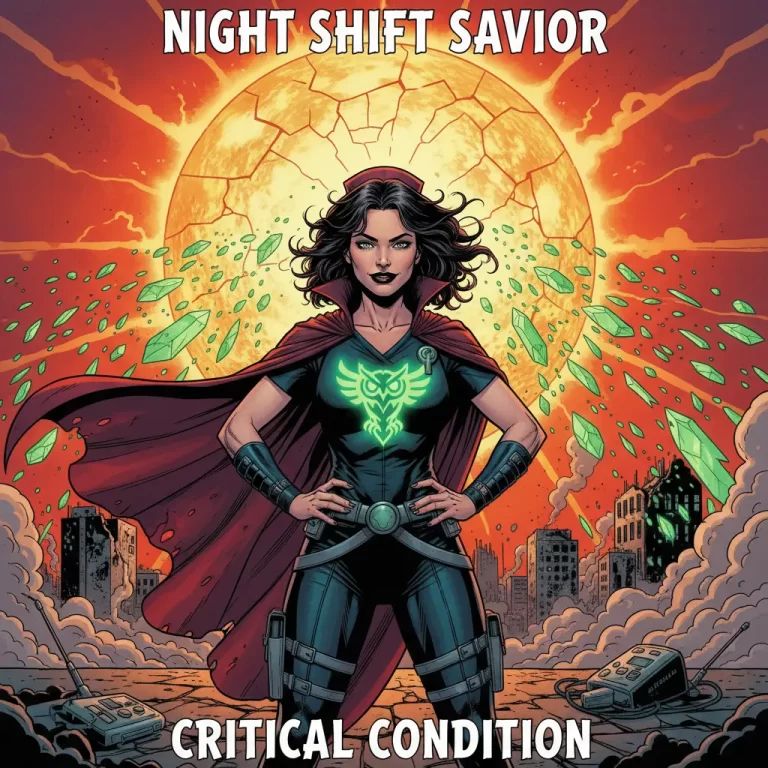
This Scroll is a historical and cultural account of Florence Nightingale and her legacy. It uses humour, modern comparisons and fictionalised imagery to connect historical events with contemporary night-shift nursing.
Some historical details about Nightingale’s health, relationships and work have been debated by historians. Where evidence is uncertain, this article avoids presenting interpretation as absolute fact.
The historical claims in this Scroll were checked against the Florence Nightingale Museum, National Army Museum, World Health Organization, Royal Statistical Society-related material and scholarly sources.
Note: The Facebook Group is our temporary launch incubator. Our fully private custom platform is under construction right here on the website!