The Survival Protocol
📜 THE FORGOTTEN SCROLLS: CHRONOLOGY OF THE NIGHT WATCH
HOW TO NEUTRALISE A TOXIC CLINICAL MANAGER AND OUTSMART HOSPITAL ADMINISTRATION
The Night-Shift Survival Protocol Nobody Put in the Nursing Manual
Did you feel it today?
That cold, heavy knot tightening in your stomach before you even stepped through the hospital doors.
That may not be “just operational fatigue.”
Sometimes your survival instinct knows something is wrong long before your professional brain is ready to admit it.
Most of us believe the most dangerous part of a graveyard shift is a cardiac arrest at 4:00 AM or a patient pacing the corridor in acute distress.
Rookie mistake.
Sometimes the most exhausting predator in the modern healthcare ecosystem is the person who is supposed to have your back.
The toxic clinical manager.
The manager who doesn’t protect the team when staffing collapses.
The manager who hunts for mistakes instead of looking at why the system keeps producing them.
The manager who turns every staffing problem into a personal failure.
And the manager who somehow has a sixth sense for finding you at 4:03 AM when you’re already running on 1% battery.
This isn’t about declaring every difficult manager a villain.
Some managers are simply under enormous pressure.
Some are inexperienced.
Some are dealing with systems that are genuinely broken.
And sometimes two people simply don’t like each other.
That’s not automatically bullying.
But when difficult behavior becomes repeated, targeted and seriously undermines a person’s dignity at work, Ireland’s Health and Safety Authority recognizes that as something that needs to be taken seriously.
So let’s stop shouting in the break room.
Let’s stop sending emotional midnight messages.
Let’s stop giving the system exactly what it needs to dismiss us as “difficult.”
It’s time to deploy the defensive protocols they never taught you in nursing school.
📜 SCROLL I: ANATOMY OF THE PARASITE
How Toxic Management Takes Root
A toxic manager doesn’t necessarily appear out of nowhere.
Sometimes the environment around them rewards the wrong behaviors.
Pressure.
Staff shortages.
Poor communication.
Weak accountability.
Competition.
Favoritism.
A culture where admitting a problem is treated as more dangerous than allowing the problem to continue.
Cheryl Dellasega’s Toxic Nursing explores bullying, incivility, relational aggression, conflict and the ways toxic behavior can damage nursing environments and patient safety.
Brenda Happell’s Sickness in Health: Bullying in Nursing and Other Health Professions similarly examines the personal and professional consequences of bullying and the way toxicity can become embedded within healthcare cultures.
The hospital doesn’t necessarily set out one morning to manufacture a tyrant.
But dysfunctional systems can certainly create an environment where bad behavior survives.
And sometimes the person holding the clipboard becomes the person everyone learns to fear.
You will recognize the warning signs.
THE PUBLIC EXECUTION — BLAME CULTURE
Every systemic failure becomes somebody’s personal fault.
The ward is dangerously understaffed.
Equipment is missing.
Transfers are delayed.
The workload is impossible.
And somehow the conclusion is:
“Why didn’t you manage it better?”
Instead of:
“Why was the system unable to support safe care?”
That distinction matters.
CALCULATED FAVOURITISM — THE ROYAL COURT
Every ward has politics.
But there is a difference between ordinary workplace relationships and a repeated pattern of people being treated very differently without legitimate reason.
The chosen few get the desirable shifts.
The difficult assignments somehow always land on the same people.
Certain staff receive endless understanding.
Others receive endless scrutiny.
The HSA specifically identifies behaviors such as targeting someone for special negative treatment, manipulation of reputation, social exclusion and unreasonable unfavorable assignments as examples that may constitute bullying when they form part of the required pattern.
That is no longer merely:
“Management doesn’t like me.”
That deserves a closer look.
CLINICAL GASLIGHTING
You’re exhausted.
You raise a legitimate concern.
You’re told you’re simply:
“Not resilient enough.”
You question unsafe staffing.
You’re told:
“That’s just nursing.”
You say you cannot keep extending your hours indefinitely.
You’re reminded of your:
“Professional duty.”
Compassion is valuable.
So is knowing when someone is using your compassion as a staffing strategy.
🔬 THE BRUTAL METRICS OF HOSPITAL HORROR
The research is increasingly uncomfortable.
A 2023 systematic review of toxic leadership in nursing found associations with poorer psychological wellbeing, work satisfaction, organizational relationships, productivity and performance, with potential implications for patient safety. The authors also emphasized that the evidence was still modest and that more research is needed on patient-safety outcomes.
A separate systematic review of abusive supervision in nursing found substantial evidence of detrimental effects on the nursing workforce, while again calling for more research into the patient-safety pathway.
And a newer 2026 review examining toxic leadership in hospital nursing found recurring negative effects on nurses’ psychological wellbeing and emotional functioning.
So we don’t need to invent horror statistics.
The real evidence is already unpleasant enough.
THE SILENCE PROBLEM
One of the most worrying issues is what happens when staff stop feeling psychologically safe enough to speak.
Effective nurse leadership has been associated with better safety culture, communication, organizational learning and reporting behaviors.
That means leadership isn’t merely a personality issue.
It can become a patient-safety issue.
When staff are frightened to raise concerns, the organization loses something extremely valuable:
information.
And hospitals without honest information are operating with the clinical equivalent of a blindfold.
🛡️ SCROLL II: THE PURE DEFENCE PROTOCOL
Collect Traces, Not Emotions
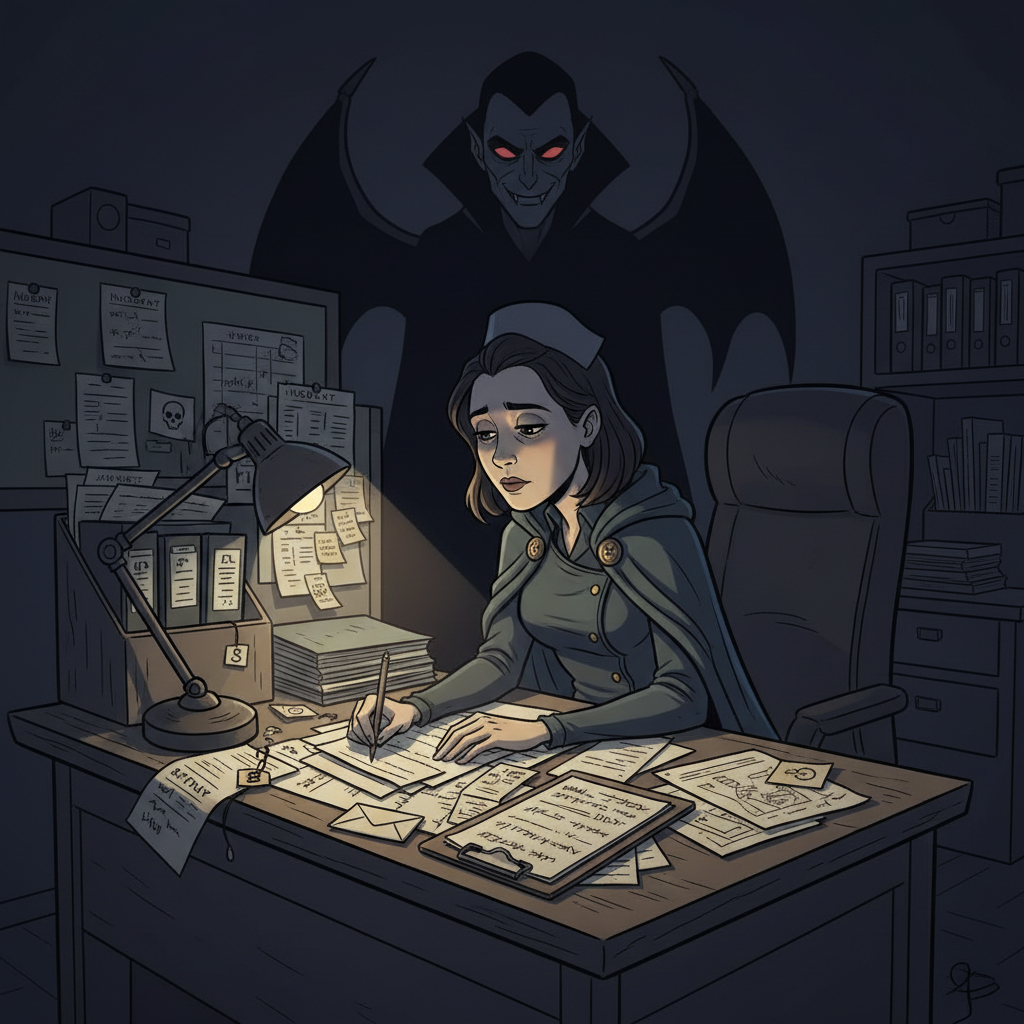
This is where we stop fighting the vampire with another vampire.
Toxic behavior feeds on emotional reactions.
If you shout in the corridor, cry in the staff room, send an angry midnight email and then accidentally write a five-page manifesto about your manager at 3:17 AM…
you may feel better.
For approximately eleven minutes.
Then you have created something management can read instead of the original problem.
So change the strategy.
Document facts.
Not revenge.
Not speculation.
Not:
“She hates me because she’s a psychopath.”
Write what actually happened.
1. THE BLACK BOX RULE — DOCUMENT EVERYTHING
Keep a contemporaneous factual record of significant incidents.
Think:
flight recorder, not revenge diary.
Record:
- date;
- time;
- location or ward;
- what happened;
- who was present;
- what was said, as accurately as you can remember;
- what action followed;
- any relevant patient-safety or staffing issue.
Avoid emotional interpretation.
Instead of:
“The manager deliberately tried to destroy me.”
write:
“At 03:20, during handover, X said [exact words]. Y and Z were present.”
That is far more useful.
The HSA specifically advises employees who believe they are being bullied to keep copies of relevant material such as notes and emails and to follow their organization’s anti-bullying policy.
ONE IMPORTANT IRISH CAVEAT
Do not turn documentation into a private hospital archive.
Do not copy confidential patient information onto personal devices.
Do not photograph patient records because you are angry with management.
Do not secretly remove documents you are not entitled to possess.
And don’t assume that sending every work email to your private cloud account is automatically safe.
Follow your employer’s policies and protect patient confidentiality.
Your evidence should protect you.
It should not create a second problem.
2. THE FIREWALL STRATEGY — PROCEDURAL RESPONSES
When someone tries to drag you into an emotional argument, don’t follow them into the swamp.
Stay clinical.
Stay factual.
Stay boring.
Boring is underrated.
Instead of:
“This isn’t fair! I can’t physically do another shift! I’m exhausted!”
try:
“Could you clarify the policy or roster requirement you’re relying on here?”
Or:
“Can you confirm that instruction in writing, please?”
Or:
“I have a concern about whether this staffing level allows me to provide care safely. What is the escalation process for this?”
Or, when appropriate:
“I am concerned that extending my working hours may affect my ability to work safely. Can we review this against the relevant policy and working-time requirements?”
That last one is particularly relevant in Ireland.
The HSE’s current guidance on the Organization of Working Time Act notes minimum daily rest of 11 consecutive hours in each 24-hour period, weekly rest provisions and a maximum average working week of 48 hours, subject to the legislation’s provisions and any applicable arrangements or exemptions.
So don’t invent a legal threat.
Ask for the policy.
There is a big difference.
3. SAFETY IN NUMBERS — BUT DO IT PROPERLY
One nurse complaining can be dismissed as:
“A personality issue.”
A repeated pattern documented by several staff members is much harder to ignore.
But collective action does not mean creating a WhatsApp group called:
“WE HATE MANAGEMENT.”
Please.
We are professionals.
Mostly.
If several staff members have experienced the same issue, consider raising concerns through the appropriate formal channels:
- your line-management structure;
- HR;
- occupational health where appropriate;
- your union or staff representative;
- the organization’s dignity-at-work or anti-bullying process;
- patient-safety reporting systems when the issue genuinely concerns patient safety.
The HSA’s Irish Code of Practice provides for informal approaches, mediation and, where necessary, formal investigation. It also emphasizes confidentiality, fairness and the rights of everyone involved.
The objective is not:
Destroy the manager.
The objective is:
Stop the behavior. Protect staff. Protect patients. Create a record.
That is much harder to dismiss.
⚠️ THE DIFFERENCE BETWEEN BULLYING, CONFLICT AND BAD MANAGEMENT
This matters.
Because if we call everything bullying, eventually the word loses meaning.
The HSA is very clear that occasional disputes, disagreements and personality clashes do not automatically meet the threshold for workplace bullying.
The Irish definition focuses on repeated inappropriate behavior that could reasonably be regarded as undermining dignity at work.
So ask yourself:
Is this one horrible interaction?
Or is this a repeated pattern?
Is the behavior targeted?
Are there witnesses or records?
Is there a measurable impact on my work, dignity or safety?
Is this poor management, ordinary conflict, harassment, bullying or a genuine patient-safety issue?
Those distinctions matter.
They protect you.
And, inconveniently, they also protect the person you’re accusing.
That’s how fair systems are supposed to work.
🚪 SCROLL III: EVACUATION OR ARMAGEDDON
Your Life Is Not Hospital Property
Eventually, you may have to ask the question nobody wants to ask:
What if the system isn’t going to change?
No Master’s degree is worth destroying yourself for.
No amount of institutional seniority is worth living permanently in fear.
No overtime premium is worth becoming physically and emotionally unrecognizable to yourself.
And no hospital owns your entire future.
There is growing evidence that toxic and abusive leadership is associated with negative outcomes for healthcare workers.
Brenda Happell’s own work makes another uncomfortable point: the effects of workplace bullying can follow people long after they leave the environment in which it happened.
Sometimes leaving is not failure.
Sometimes it is the first intelligent clinical decision you have made for yourself in years.
💥 THE STRATEGIC RETREAT
Leaving does not have to mean:
“I lost.”
It can mean:
“I have collected enough information to realize this environment is not worth the cost.”
Maybe you transfer.
Maybe you change departments.
Maybe you move hospitals.
Maybe you take a different contract.
Maybe you seek union advice.
Maybe you stay — but with much stronger boundaries.
Maybe you leave healthcare altogether.
The correct answer is not the same for everyone.
But there is one answer I don’t recommend:
Destroying yourself just to prove that you can survive a place that is harming you.
That’s not resilience.
That’s attrition with better branding.
🩸 THE SERVICE SHUTDOWN
There is a strange arrogance in healthcare systems that assume compassionate professionals will absorb unlimited pressure indefinitely.
They won’t.
People leave.
People transfer.
People reduce hours.
People stop volunteering for extras.
People stop covering every staffing hole.
And eventually the organization has to deal with the consequences.
That isn’t revenge.
It’s arithmetic.
But don’t make your personal exit into a crusade to bring the hospital down.
You don’t need to burn the castle.
You just need to stop living inside it if it’s killing you.
🇮🇪 THE IRISH SURVIVAL DESK
When the problem leaves the ward and enters your working life
If the situation you are dealing with is more than an unpleasant personality clash, do not rely on a random internet warrior telling you what your legal rights are.
Use the actual Irish systems designed for this.
Because sometimes the most rebellious thing you can do is read the policy.
And yes, I realize how deeply unromantic that sounds.
But nothing ruins a toxic manager’s dramatic little power trip faster than a nurse calmly turning up with the correct policy, documented facts and a union representative.
So before you declare war on the hospital kingdom, know where the actual doors are.
🛡️ HSE — Dignity at Work
If you work in the public health service, the HSE Dignity at Work Policy provides the framework for dealing with bullying, harassment and sexual harassment.
It explains what may constitute bullying, what generally does not constitute bullying, and the informal and formal procedures available to staff.
The policy also identifies several support routes, including HR, Occupational Health, trade unions and Support Contact Persons.
A Support Contact Person is a trained HSE employee who can provide confidential, non-judgmental information about the policy and the options available to you. They do not act as your representative or speak to the person you are complaining about on your behalf.
If you are not sure whether what is happening actually meets the definition of bullying, start here.
You don’t have to arrive at the hospital gates carrying a flaming torch and a 47-page grievance.
You can start by understanding the rules.
⚖️ WRC — Code of Practice on Workplace Bullying
The Workplace Relations Commission (WRC) and Health and Safety Authority have a joint Code of Practice covering the prevention and resolution of workplace bullying in Ireland.
It provides guidance for employers and employees dealing with bullying complaints and sets out a framework for preventing and addressing workplace bullying.
This is important because Irish workplace bullying is not simply:
“My manager is horrible.”
The HSA describes bullying as repeated inappropriate behavior, direct or indirect, which could reasonably be regarded as undermining a person’s dignity at work. An isolated incident may be offensive or unacceptable without meeting the definition of bullying.
That distinction matters.
Read the rules before you start the war.
Preferably before the war starts.
WRC — Code of Practice on Workplace Bullying
🚨 HSA — Bullying at Work
The Health and Safety Authority (HSA) treats workplace bullying as a workplace health and safety issue.
Its guidance explains the definition of bullying, examples of behavior that may constitute bullying, the responsibilities of employers and employees, and the importance of appropriate procedures and risk controls.
The HSA also advises employees who believe they are being bullied to:
- keep copies of relevant notes and emails;
- maintain confidentiality;
- check their organization’s anti-bullying policy;
- and follow the appropriate procedure.
If you believe there is a genuine workplace health and safety issue, the HSA also provides information about raising workplace concerns.
Because sometimes:
“Please be more resilient”
is not a risk-control measure.
🤝 YOUR UNION
If you are a member of a trade union, use it.
Do not wait until the situation has escalated into a full-scale psychological siege before contacting your representative.
A union representative may be able to help you understand:
- your workplace procedures;
- your contractual position;
- grievance or disciplinary processes;
- representation at meetings;
- and what steps may be appropriate in your particular circumstances.
The HSE itself identifies trade unions as one of the support routes available to employees dealing with dignity-at-work concerns.
And unlike the advice from your cousin’s friend’s neighbor who once worked in HR in 2007, your union actually knows the employment environment you’re dealing with.
You paid your membership fee.
This is one of the reasons it exists.
🧠 OCCUPATIONAL HEALTH & EMPLOYEE SUPPORT
If the situation is beginning to affect your health, sleep, confidence or ability to function outside work, don’t wait until you are completely broken.
The HSE identifies Occupational Health and the Employee Assistance Programme (EAP) among the support options available to employees.
HSE Occupational Health provides a confidential, independent advisory service focused on employee health and wellbeing. The HSE EAP provides confidential support, including short-term counselling, for psychosocial issues that may be work-related or personal.
For HSE employees, the current National HR Helpdesk contact details are:
📞 1800 444 925
The HSE EAP can also be accessed by self-referral. The current HSE information lists:
📞 0818 327 327
If your workplace situation is affecting your mental health, asking for support is not an admission that you are weak.
You are a human being.
Annoying design flaw, but apparently that’s how the species works.
HSE — Dignity at Work & Employee Support
🕯️ AND IF THE PROBLEM IS YOUR HOURS?
Sometimes the manager isn’t shouting.
Sometimes nobody is calling you names.
Sometimes the problem is simply that the expectation has quietly become:
Always available.
Extra shifts.
Messages on days off.
Meetings scheduled around everybody except the night staff.
Working through breaks.
Staying late because there isn’t enough staff.
Being made to feel guilty because you don’t volunteer for yet another shift.
For HSE and Section 38 employees, the HSE also has a Right to Disconnect Policy, which addresses situations including regular contact outside normal working hours, routinely working longer than contracted hours, being unable to leave work on time because of excessive workload, and unfavorable treatment for not being available outside normal working hours.
That doesn’t mean every extra request is automatically unlawful.
It means you should know the framework before assuming that exhaustion is simply part of the job.
🩸 ONE FINAL WARNING FROM THE NIGHT WARDEN
This article is about survival.
It is not a substitute for legal advice, union representation, HR advice, occupational-health assessment or professional psychological support.
Every employment situation is different.
Your contract matters.
Your workplace policy matters.
The facts matter.
And Irish employment law is considerably more complicated than a dramatic paragraph written by a sleep-deprived nurse with a keyboard and unresolved feelings about management.
Do your homework.
Keep your records factual.
Protect confidentiality.
Use the proper channels.
And if you need help understanding what is happening, ask someone qualified before making your next move.
You don’t have to fight the entire hospital tonight.
Sometimes the first victory is simply understanding the battlefield.
They may have the clipboard.
You have the policy.
Know how to use it.
🛡️ THE FINAL DEFENCE: PROTECT THE CLINICIAN
The original version of this article suggested that toxic management causes the body to “burn through electrolytes and B-vitamins” and that supplements could protect you from the physical consequences of stress.
We’re not doing that.
Stress is real.
The physiological response is real.
But there is no magical B-vitamin shield that makes a toxic workplace harmless.
Hydrate.
Eat properly.
Sleep when you can.
Use your annual leave.
Move your body.
Talk to someone you trust.
Use occupational-health support when appropriate.
And if your mental health is deteriorating, seek actual professional help.
Not a capsule.
Not a motivational poster.
Not a LinkedIn quote from a man standing beside a Lamborghini.
Actual help.
Your nervous system deserves better than corporate wellness theatre.
🧛♀️ THE VAMPIRE SHIFT RULE
Here is the rule I want every night-shift nurse to remember:
Don’t fight a toxic system emotionally when you can respond strategically.
Document.
Verify.
Ask questions.
Use policy.
Use your union.
Use formal channels.
Protect patient confidentiality.
Protect your working-time rights.
Protect your professional registration.
Protect your mental health.
And above all:
Protect your exit route.
Because sometimes the most powerful thing you can say to a toxic manager is not:
“You can’t treat me like this.”
It’s:
“I don’t have to stay here.”
They might manage the unit.
But you command your life.
🚪 ACCESS THE AIRLOCK
If you’ve ever stood in a staff bathroom at 4:00 AM trying not to cry because someone has spent the entire shift making you feel like a clinical failure…
you’re not the only one.
If you’ve ever stared at a roster wondering how the same people always seem to get the good shifts…
you’re not the only one.
If you’ve ever been told that exhaustion is a character flaw…
you’re definitely not the only one.
And if you’ve ever wondered whether you were imagining the whole thing…
document first.
Then breathe.
The Asylum Sanctuary exists for the conversations that don’t fit neatly into the corporate wellness newsletter.
A private, deliberately moderated digital space for frontline night-shift workers.
Drop the professional filter.
Share the trench stories.
Share the dark humor.
Talk about the things you cannot say during handover.
And maybe, just maybe, discover that the problem wasn’t that you were too sensitive.
Maybe you were simply working in an environment that had forgotten what dignity looks like.
The Sanctuary is free to join and designed to remain independent from corporate advertising. The Owl Nurse helps support the work behind it.
No HR script.
No forced positivity.
No:
“Have you tried mindfulness?”
Just people who understand the night.
Take off your sterile gloves.
Close the break-room door.
Open the evidence file.
And remember:
You are a nurse.
You are not hospital property.
Your coven is waiting.
🦉 A NOTE FROM THE NIGHT WARDEN
This article is intended for education, reflection and peer support. It is not legal advice, employment advice, union representation or psychological treatment.
Workplace conflict, poor management, harassment and bullying are not necessarily the same thing. In Ireland, the HSA/WRC Code of Practice provides a framework for addressing workplace bullying, including informal resolution, mediation and formal investigation where appropriate.
If you believe you are experiencing bullying or another serious workplace issue, consult your employer’s relevant policy and consider speaking with your union, staff representative, HR, occupational-health service or another appropriate professional.
When documenting workplace events, protect patient confidentiality and follow your employer’s information-governance policies.
And one final thing:
You don’t have to become cruel to survive a cruel environment.
You just have to become harder to manipulate.
Note: The Facebook Group is our temporary launch incubator. Our fully private custom platform is under construction right here on the website!