Things I Thought Nursing Would Be vs. What the Shift Actually Taught Me
📜 THE FORGOTTEN SCROLLS: CHRONOLOGY OF THE NIGHT WATCH
Things I Thought Nursing Would Be vs. What the Shift Actually Taught Me
Before you get those two shiny letters after your name, nursing can look suspiciously like a high-stakes medical drama.
You watch TV shows. You read nursing-school brochures. You imagine pristine corridors, dramatic music, beautifully timed chest compressions and grateful families looking at you as though you personally invented modern medicine.
You think you are entering a profession built around heroic moments.
Then you actually step onto the floor.
And eventually you meet the night shift.
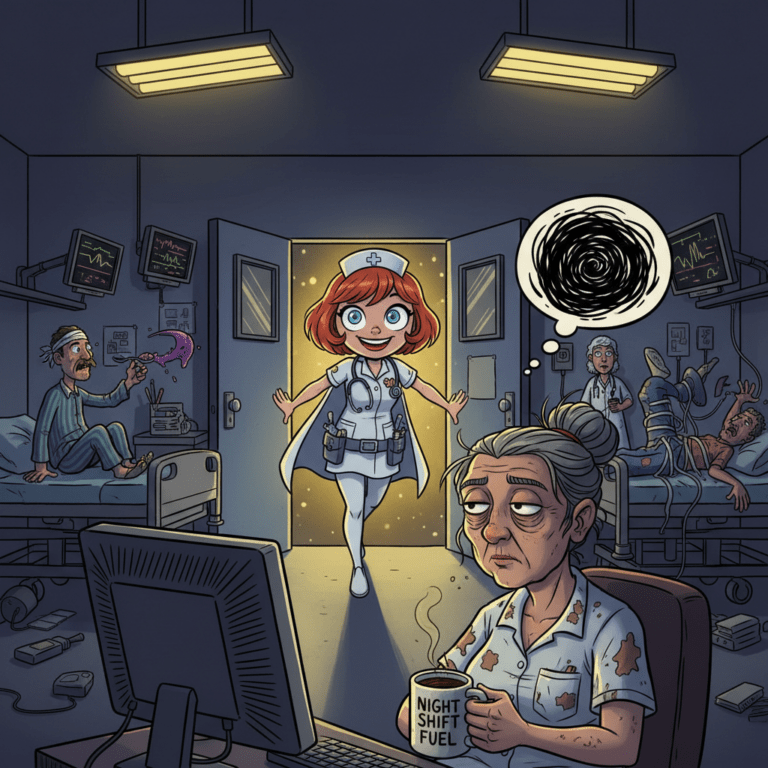
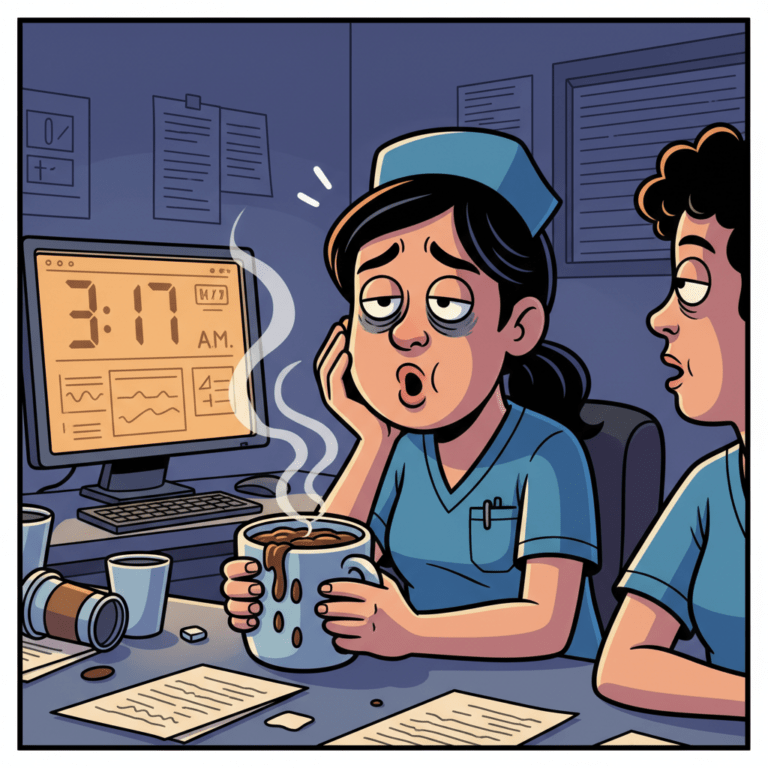
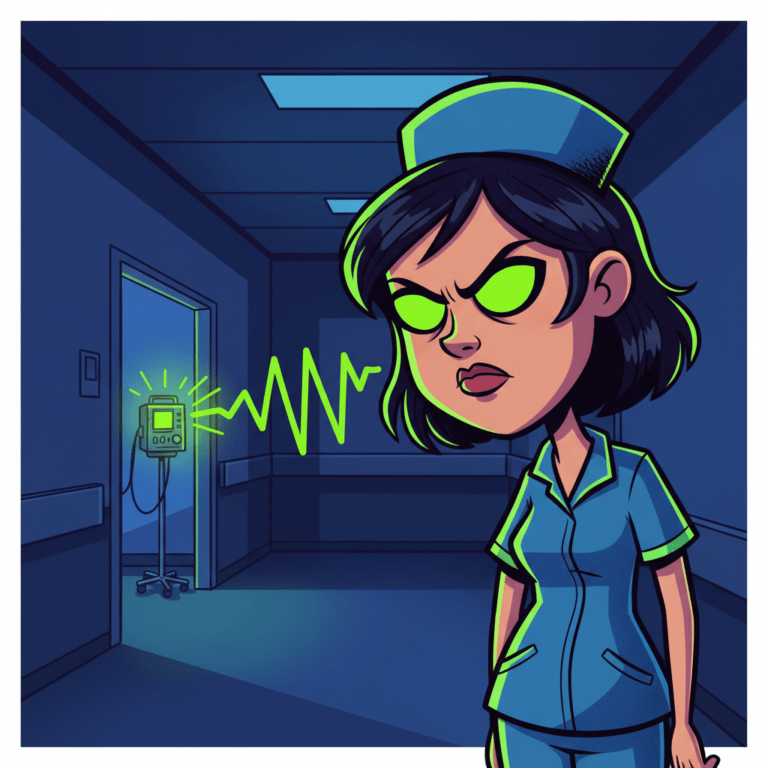
The fluorescent lights flicker like a horror movie. The coffee tastes faintly of battery acid. Somebody has misplaced the only working pen. There is a mysterious puddle near the nurses’ station and absolutely nobody wants to investigate it.
Six months later, your romantic nursing fantasy hasn’t simply faded.
It has been found dead at approximately 04:17 AM beside an empty linen trolley.
The reality is much stranger.
Nursing doesn’t turn you into a TV-show character. It gives you experience, pattern recognition, dark humor, and an impressive ability to function when the rest of your brain would prefer to file for bankruptcy.
And if you work enough night shifts, you learn a few things nobody bothered to put in the prospectus.
1. The Hero Complex vs. The Stationery Cartel
The Fantasy
I genuinely believed I would become a modern-day superhero.
I imagined chest compressions, dramatic Code Blues, brilliant clinical observations that would leave everyone speechless, and families who would remember my name forever.
I thought I would go home after each shift, make a cup of tea, stare thoughtfully out of the window and think:
I made a difference today.
Very cinematic.
Very wholesome.
Very wrong.
The Reality
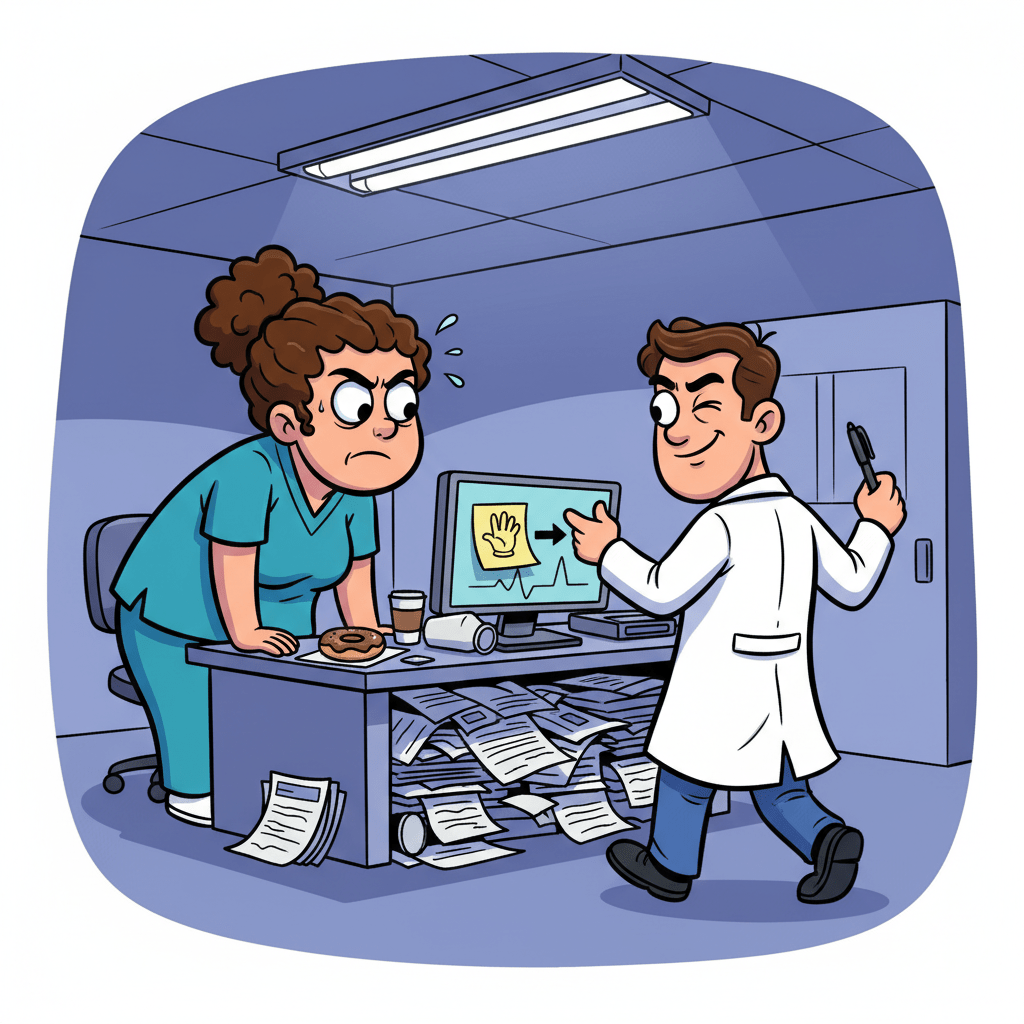
I spend an astonishing amount of my working life hunting for pens.
Nobody tells you that nursing involves joining an underground stationery economy where a working black pen is basically currency.
You leave one on the workstation for approximately forty-two seconds.
It disappears.
You ask around.
Nobody has seen it.
You look at the doctor who just borrowed it.
They look back at you with the completely innocent expression of someone who absolutely has your pen.
The pen is never seen again.
Eventually, you find it three shifts later in a completely different clinical area, apparently starting a new life.
And yes, there are bigger problems in healthcare.
But at 03:00 AM, when you have six things to document and your last pen has mysteriously emigrated, this suddenly feels personal.
The heroic moments still happen.
But so do the sandwiches.
People will complain about their Wi-Fi while you’re trying to manage a deteriorating patient.
Someone will ask whether their tea can be warmer while you’re mentally running through your clinical priorities.
And somehow you learn to smile professionally while your internal monologue quietly says:
Interesting choice of moment to discuss the mayonnaise.
Nursing didn’t make me a saint.
It taught me how to remain polite while conducting an internal criminal investigation.
2. Grace Under Pressure vs. The Linen Trolley Meltdown
The Fantasy
I thought I would become a pillar of calm during medical emergencies.
A monitor would suddenly alarm.
A patient would deteriorate.
Everyone else would panic.
And I would step forward with ice in my veins, calmly drawing up medications and executing the plan like someone who had been specifically manufactured for emergencies.
The Reality
The strange thing is…
Sometimes I actually am calm during the emergency.
When a patient is genuinely deteriorating, the brain can become intensely focused. There is a problem. There is a priority. There is a team. There is a protocol.
You deal with what is in front of you.
But give me a 03:00 AM linen shortage?
Different woman.
If a patient has gone through several sets of sheets and I walk into the corridor only to discover that our last clean linen trolley has mysteriously disappeared, suddenly the entire universe feels hostile.
Where are the sheets?
Who took the sheets?
Why are there twelve nurses on the floor and not one person knows where the sheets are?
Who has been hoarding them?
Do I need to involve Interpol?
Emergency situations have protocols.
There is no protocol for:
“Why does this ward have exactly one fitted sheet and seventeen disposable pillowcases?”
Nursing taught me something important:
Human beings can adapt remarkably well to serious clinical pressure.
But remove the basic supplies and civilization starts looking fragile.
The hospital doesn’t collapse because of one missing linen trolley.
But at 03:15 AM, it certainly feels like it might.
3. The Master Organizer vs. The Black Hole of Scrub Pockets
The Fantasy
As a student, I looked at experienced nurses and thought:
They have their lives together.
The color-coded notes.
The organized pockets.
The neat handwriting.
The mysterious ability to know exactly where everything is.
I assumed experience would eventually transform me into a beautifully efficient human filing system.
The Reality
My scrub pockets are now a small archaeological site.
I have found:
- alcohol swabs,
- tape,
- hair ties,
- trauma shears,
- old receipts,
- gloves,
- random pieces of paper,
- a pen that isn’t mine,
- and approximately seventeen objects whose original purpose I have completely forgotten.
I can put something into my pocket at 20:00 and have absolutely no idea where it went by 23:00.
Then, during a crisis, my hand dives into the pocket without me even looking and somehow finds exactly what I need.
That part is genuinely useful.
The rest is chaos.
At work, my organization is often an illusion created by adrenaline.
I make a beautiful plan.
Then the call bell goes.
Then the phone rings.
Then somebody needs help.
Then somebody else needs help.
Then the computer freezes.
Then someone asks where the doctor is.
Then the doctor asks where the patient is.
Then the printer develops a spiritual problem.
By 07:00, my carefully organized notes resemble a document that survived a small natural disaster.
At home, I have learned to triage differently.
The bathroom can wait.
The laundry can wait.
The floor can definitely wait.
If my feet feel like they have been constructed from broken glass and my brain has enough energy to operate exactly one household appliance, that appliance is probably the kettle.
Nursing didn’t teach me perfect organization.
It taught me priorities.
Which, frankly, is more useful.
4. Deep Human Connection vs. The Olfactory Radar
The Fantasy
I imagined beautiful moments of human connection.
Sitting beside an elderly patient who couldn’t sleep.
Holding someone’s hand.
Listening to their story.
Offering reassurance at exactly the right moment.
Those moments do happen.
And they matter.
But nursing also develops some less poetic skills.
The Reality
After enough shifts, you become extremely aware of your environment.
You notice sounds.
You notice changes in behavior.
You notice the way someone looks when they’re not quite themselves.
You notice when a room smells different.
You notice when something is out of place.
And sometimes your brain quietly says:
Something isn’t right here.
That can be useful.
It is also important not to turn it into superhero mythology.
No, your nose has not become a laboratory.
You cannot reliably diagnose C. diff, a GI bleed or an infection by walking past a room and inhaling dramatically like Sherlock Holmes in scrubs.
You can notice an unusual or concerning odor.
You can recognize that something has changed.
And then you assess the patient properly.
That’s the less glamorous version.
But it’s also the real one.
Experience teaches you to notice more.
And sometimes that tiny observation becomes the beginning of a much more important clinical assessment.
The other thing nursing gives you is a very specific kind of friendship.
It’s 04:00 AM.
You’re sitting in the breakroom eating cold pizza.
Someone says something completely inappropriate.
You look at each other.
You both start laughing.
Nobody else would understand why it’s funny.
You don’t even need to explain.
That is the night shift.
Not elegant.
Not cinematic.
But strangely human.
5. The Schedule Freedom vs. The Zombie Timeline
The Fantasy
I’ll only work three days a week.
Perfect.
Four days off!
I’ll go to the gym.
I’ll travel.
I’ll learn Italian.
I’ll finally organize the house.
I’ll become one of those people who makes sourdough.
Perhaps I’ll even develop a personality outside nursing.
The Reality
Those days off are not necessarily days off.
Some of them belong to recovery.
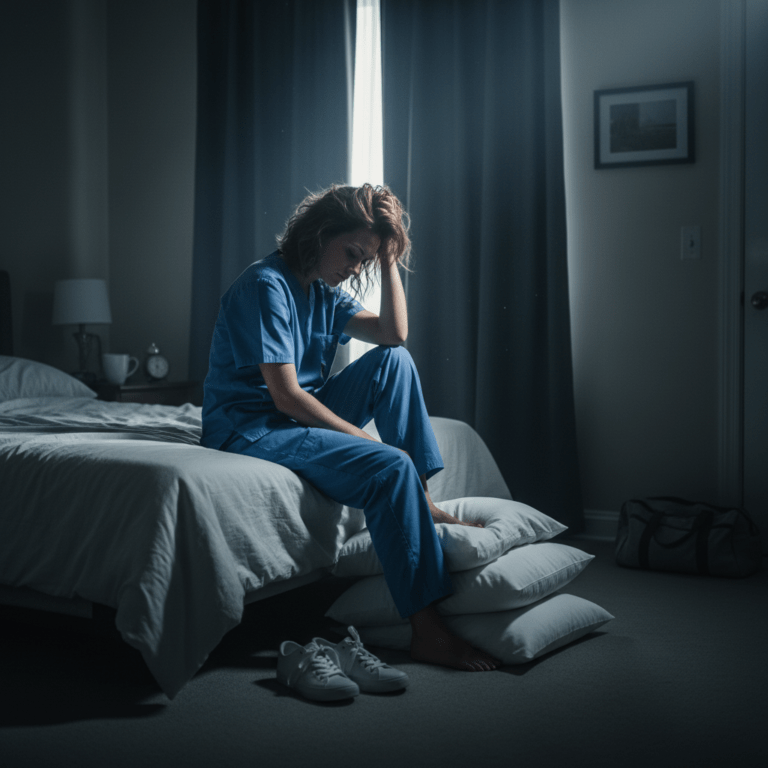
Especially after night work.
Night shifts can disrupt sleep timing and recovery, and fatigue can affect attention, cognition and safety. That’s not just vampire folklore. Research in healthcare workers has repeatedly linked inadequate sleep and shift work with poorer cognitive and safety outcomes.
So your first day off may look less like:
“Freedom!”
and more like:
“Please do not speak to me unless the house is on fire.”
You go to the supermarket and stand in front of the cereal aisle for ten minutes.
Not because there are too many options.
Because your brain has spent the last twelve hours making decisions and has now officially resigned.
You stare at the oats.
The oats stare back.
Neither of you moves.
Your body clock is also having its own little rebellion.
You sleep while everyone else is awake.
You wake while everyone else is preparing dinner.
You have conversations with people who say:
“What day is it?”
And you genuinely don’t know.
Then you discover it is Wednesday.
You thought it was Sunday.
You have somehow lived three separate timelines since Monday.
Welcome to nursing.
🖤 The Verdict: The Mutation Is Real
Nursing didn’t change my life in the neat, inspirational way the brochures promised.
It didn’t turn me into an angelic figure of mercy floating through hospital corridors with a gentle smile.
It gave me something much stranger.
It taught me how to function when things are messy.
How to notice small changes.
How to prioritizes.
How to stay calm when the situation demands it.
How to laugh when the alternative is screaming into a linen cupboard.
It gave me a dark sense of humor that occasionally makes perfectly normal people leave the dinner table.
It taught me that a missing pen can become a full psychological event.
That an empty supply cupboard can destroy morale faster than a motivational poster can rebuild it.
That your carefully planned shift can disappear in approximately twelve seconds.
And that sometimes the most meaningful part of the job isn’t the dramatic emergency.
Sometimes it’s the quiet conversation.
The extra blanket.
The patient who finally stops being frightened.
The colleague who notices you’re struggling before you say anything.
The ridiculous joke at 04:30 that somehow gets everyone through the next three hours.
You don’t necessarily become less human.
You become hyper-aware of other humans.
That’s the real mutation.
And once your brain has spent enough time on the floor, you never quite see the world the same way again.
You hear a pump alarm in a supermarket and your head turns.
Someone says, “Excuse me, nurse,” on your day off and your entire nervous system briefly reports for duty.
You see a badly stocked cupboard and experience a level of rage normally reserved for international diplomacy.
And somewhere deep inside your brain, the Vampire Shift is still awake.
Welcome to the club.
Go drink some water.
Wash your scrubs.
Find your pen.
And for the love of God, don’t say the Q-word.
The moon has been scientifically cleared.
The ward has not.
🚪 Access the Airlock: Your Coven Is Waiting
You’ve survived the shift.
The missing pens.
The disappearing linen.
The mysteriously empty supply cupboard.
The patient who somehow needed something exactly when you finally sat down.
And somehow, you’re still here.
That’s the strange thing about nursing.
Somewhere between the alarms, the exhaustion and the completely ridiculous moments, you find people who understand.
People who don’t need the whole story.
You can just say:
“You know what happened at 4:00 AM.”
And they already know.
Before you step back into the daylight, put on your sunglasses and return to pretending you are a functioning member of civilian society, step through the airlock into The Asylum Sanctuary — our private digital fortress for frontline night-shift professionals.
Drop the professional filter.
Leave the polished version of the story at the hospital door.
Share the ridiculous moments, the difficult ones, the dark humor, the stories you probably shouldn’t tell at brunch, and the tiny victories nobody else noticed.
Because sometimes the people who understand you best are the ones sitting under the same fluorescent lights at 03:00 AM, running on caffeine, instinct and approximately 1% battery.
The Asylum Sanctuary is 100% free, independent, and proudly sponsored by The Owl Nurse.
🦉 ENTER THE ASYLUM SANCTUARY →
Bring your stories.
Bring your dark humor.
Bring the pen you definitely didn’t steal.
The night shift is waiting. 🦉
Note: The Facebook Group is our temporary launch incubator. Our fully private custom platform is under construction right here on the website!