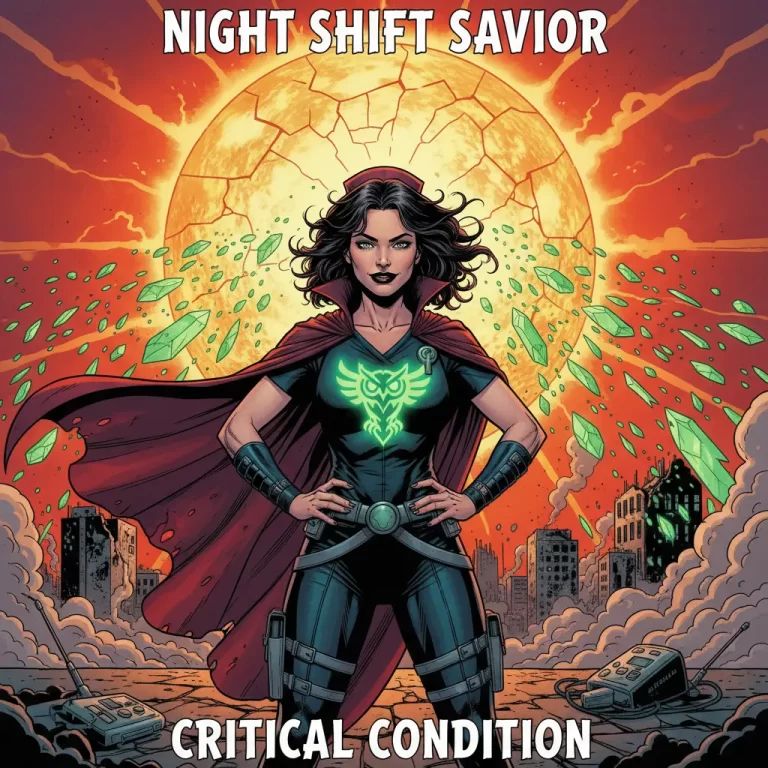
THE GRAVEYARD GURU: 10 Rules for Surviving the Night Shift | The Graveyard Nurse

📜 THE FORGOTTEN SCROLLS: CHRONOLOGY OF THE NIGHT WATCH
The Graveyard Nurse — 10 Ancient, Sarcastic Rules for Surviving the Midnight Chaos
An unapologetic survival manual for nurses running on caffeine, clinical instinct and approximately 1% remaining battery.
When you look up at the institutional ceiling lights, you probably pray for a small cosmic miracle:
A patient who actually sleeps.
Management that understands basic arithmetic.
And a coffee machine that doesn’t taste like a chemical hazard.
Instead, Bed 4 is calling for the ninth time, someone needs a doctor, the computer has frozen, and there is a mysterious puddle forming near the nurses’ station that nobody wants to legally claim.
Welcome to the graveyard shift.
After enough nights, you stop expecting the ward to behave like a normal place.
You learn to work with the chaos.
You learn what deserves your attention.
You learn what can wait.
And, perhaps most importantly, you learn that you cannot pour your entire nervous system into every problem that walks through the door.
These are the rules I wish somebody had handed me before my first serious stretch of nights.
No pastel wellness brochure required.
#1. Exorcise the Black Clouds
They exist on every ward.
The colleague who has been angry since 1998.
The person who can turn a perfectly normal conversation into a forty-minute complaint about management.
The supervisor who somehow appears at exactly the moment your remaining patience has reached zero.
And sometimes, yes, the patient or relative who is frightened, distressed or simply having an absolutely terrible night.
Not every difficult person is toxic.
Not every complaint should be ignored.
But you also don’t have to absorb everybody else’s emotional weather.
At 2:30 AM, your social battery is already flashing red.
So learn the difference between listening and carrying.
If someone genuinely needs support, give it.
If there is a legitimate workplace problem, deal with it through the appropriate channels.
But if somebody simply wants to throw their entire emotional backpack onto your shoulders while you are already carrying your own?
You are allowed to put the backpack down.
Protect your clinical perimeter.
#2. Keep Your Clinical Sheet Clean
Documentation at 3:00 AM is nobody’s idea of entertainment.
But it matters.
When the ward turns into a circus, the temptation to think I’ll chart it later becomes dangerously attractive.
Don’t.
Document what you need to document accurately and contemporaneously, according to your local policy and professional requirements.
Record the relevant assessment, intervention, response and escalation.
Don’t invent detail.
Don’t guess.
Don’t retrospectively turn the night into a beautifully organized story that never actually happened.
And don’t document simply to protect yourself while forgetting why the record exists in the first place:
patient care and communication.
Good documentation is not glamorous.
It is one of those boring little pieces of nursing that becomes extremely important when somebody needs to understand what happened six hours later.
Protect your professional record.
It is much more useful than dramatic speeches in the staff room.
#3. The Currency of Trust: Don’t Promise What You Can’t Deliver
Never make a promise at 3:00 AM that your exhausted 7:30 AM self is going to regret.
Don’t tell a patient you’ll personally solve every problem before morning if that isn’t actually within your role or control.
Don’t tell your colleague:
“Don’t worry, I’ll definitely get that done.”
when you already have six things waiting.
You don’t have unlimited time.
You don’t have unlimited energy.
And you definitely don’t have a secret second nurse hiding in your locker.
If you can do something, say yes.
If you cannot, communicate early.
If priorities change, say so.
People can work with an honest “I can’t get to that safely right now.”
They cannot work with a confident promise followed by silence.
Trust on a night shift is built in very small pieces.
Keep yours intact.
#4. Accept the Chaos You Cannot Control
The agency nurse didn’t arrive.
The computer system is behaving like it has entered another dimension.
The ward is short.
The admission is coming.
The printer has chosen violence.
And somehow someone has ordered a patient meal that contains seventeen dietary contradictions.
You can be angry about all of it.
Sometimes you should be.
Unsafe staffing and broken systems are not things individual nurses can simply breathe away.
But there is a difference between recognizing a problem and allowing the problem to consume every ounce of your attention.
Ask yourself:
What can I actually do right now?
Prioritizes.
Escalate.
Communicate.
Use your team.
Follow the relevant procedure.
Then keep moving.
You are the nurse on the floor.
You are not the CEO of the hospital.
The building can wait for your strategic five-year plan.
Bed 4 probably cannot.
#5. Protect Your Little Kingdom
You arrive at 7:15 PM.
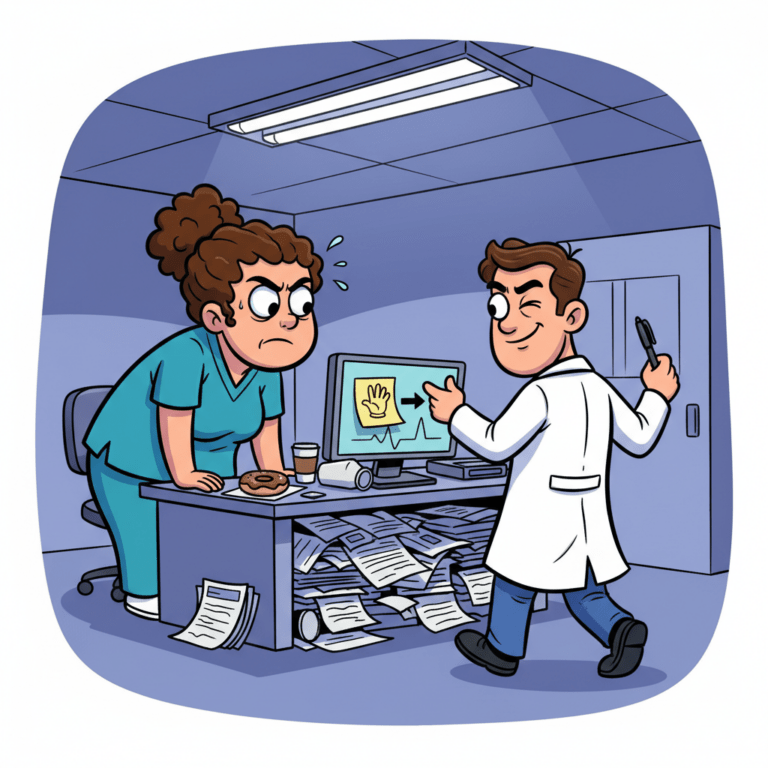
The nurses’ station looks like a tactical explosion.
Half-eaten biscuits.
Sticky notes.
Loose paperwork.
Charging cables breeding in captivity.
Pens that have apparently migrated to another continent.
Before the night really begins, create some order where you can.
Clear what can be cleared.
Put things where they belong.
Keep your workspace functional and safe.
Not because a perfectly organized desk will magically transform healthcare.
It won’t.
But unnecessary clutter is one more thing competing for your attention.
At 4:00 AM, your brain has enough enemies.
It doesn’t need to hunt for a pen as well.
Create your little command center.
The kingdom may still be dysfunctional.
But at least the coffee cup knows where it lives.
#6. Do Not Forget Your Own Biological Grid
This is the great nursing paradox.
We spend twelve hours checking everybody else’s observations while treating our own body like an optional accessory.
You need food.
You need fluids.
You need appropriate breaks.
You need movement.
And, tragically, you need sleep.
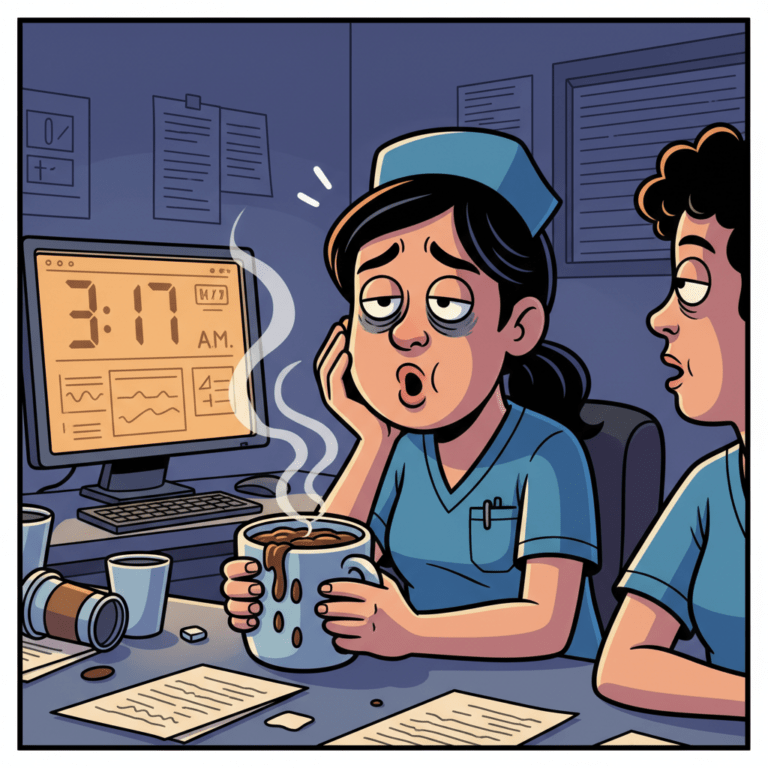
Night work and long shifts can produce substantial fatigue and sleepiness. Research on nurses working successive 12-hour shifts has documented substantial fatigue, sleepiness and insufficient recovery.
NIOSH also highlights the combination of demanding healthcare work, long/night shifts, insufficient sleep and inadequate recovery as important contributors to fatigue.
So no, running yourself into the floor is not evidence of professional dedication.
If your workplace arrangements and patient-care demands allow you to take an appropriate break, take it.
A short break isn’t going to cure burnout.
But research on micro-breaks suggests that brief recovery periods can produce small but meaningful improvements in fatigue and wellbeing.
You are not a disposable hospital resource.
Annoying, I know.
You are a human being.
#7. Don’t Run Away From the Hard Decisions
At 3:45 AM, complicated clinical situations feel even heavier.
Your brain is tired.
Your body wants a bed.
Your coffee has stopped pretending to help.
And there is always a temptation to think:
“The morning team can deal with this.”
Sometimes something genuinely can wait.
Sometimes it absolutely cannot.
If a patient is deteriorating, assess appropriately, use the relevant local early-warning or escalation system, communicate clearly and seek senior help.
Don’t delay because you’re tired.
Don’t pass the problem sideways because you’re uncomfortable.
And don’t confuse independence with refusing help.
Clinical judgement is an important part of recognising deterioration, but it works alongside objective assessment, vital signs, structured systems, communication and teamwork.
That’s the real night-shift skill:
knowing when to handle something yourself and knowing when to call another human being.
There is no prize for being the last person standing.
#8. Accept the Discomfort — But Never Sign the Defeat Contract
The graveyard shift can be physically brutal.
Your lower back complains.
Your feet burn.
Your shoulders become two concrete slabs.
Your brain becomes increasingly interested in the philosophical question of whether four consecutive hours of sleep still counts as a personality.
Fatigue is real.
Physical discomfort is real.
But neither should become an excuse for careless practice.
If you’re too fatigued to work safely, that is something to take seriously, not something to decorate with heroic language.
Don’t wear exhaustion like a medal.
Listen to it.
Use your workplace processes.
Speak up when you need help.
And when something is genuinely affecting your ability to function safely, don’t pretend otherwise because you think being exhausted makes you more professional.
It doesn’t.
It makes you exhausted.
#9. Focus on the Human Being in Front of You
Modern healthcare can bury you under numbers.
Metrics.
Emails.
Mandatory training.
Dashboards.
Compliance charts.
Password resets.
Another password reset because apparently the first password was too easy to remember.
But underneath all of it, there is still a human being in the bed.
A frightened person.
An uncomfortable person.
A confused person.
Sometimes a very annoying person.
Still a person.
The bedside is where your nursing becomes real.
Assess.
Listen.
Observe.
Communicate.
Do the work that actually belongs to the patient in front of you.
And when the administrative noise becomes overwhelming, remember why the paperwork exists in the first place.
Not because someone in an office enjoys spreadsheets.
Well…
probably not only because of that.
#10. Leave the Ward Behind the Doors
This is the rule I care about most.
At 7:31 AM, handover is finished.
The bleep is gone.
The doors close behind you.
And the night is over.
Not every mistake needs to follow you home.
Not every rude comment deserves three hours of analysis in bed.
Not every difficult patient needs to become a permanent resident inside your head.
If something needs action, document it appropriately and deal with it through the right route.
If something needs reflection, reflect when you’re rested.
But if the shift is simply…
over?
Let it be over.
Take the lessons.
Leave the noise.
The morning sun may be offensively bright.
Put on your sunglasses.
Go home.
Your job now is recovery.
🦉 THE GRAVEYARD NURSE’S REAL SECRET
After enough night shifts, you realize that survival isn’t about becoming harder.
It’s about becoming more selective.
You don’t need to react to everything.
You don’t need everyone to like you.
You don’t need to fix the entire hospital.
You don’t need to prove that you can function indefinitely without sleep.
You need to know what matters.
You need to know when to speak.
You need to know when to ask for help.
And you need to know when the shift is finished.
That’s not weakness.
That’s experience.
That’s survival.
And that’s probably as close to ancient wisdom as a nurse with a cold coffee is ever going to get.
🚪 ACCESS THE AIRLOCK: YOUR COVEN IS WAITING
The daytime world will never completely understand what happens between midnight and sunrise.
They think mindfulness is a colorful app.
We know it can be standing at the nurses’ station at 4:30 AM, listening to another call bell and deciding, very deliberately:
I am not going to lose my mind over this.
You don’t have to carry the whole night alone.
Before you surrender to your blackout curtains, step through the airlock into The Asylum Sanctuary — a private digital space for frontline night-shift workers.
The hospital can keep the fluorescent lights.
We’ll keep the dark.
🦉
Your coven is waiting.
Note: The Facebook Group is our temporary launch incubator. Our fully private custom platform is under construction right here on the website!
CONNECTING THE MIDNIGHT MATRIX WITH REAL-WORLD SURVIVAL
The Forgotten Scrolls is part of the Vampire Shift community by The Owl Nurse — a collective created to ground your nocturnal sacrifices, protect your sanity, and map your financial escape route from the night shift.
MEDICAL & CONTENT LIABILITY DISCLAIMER: The information and content provided on this platform (including The Owl Nurse shop, The Forgotten Scrolls blog, and The Asylum Sanctuary forum) is for general informational, educational, and community support purposes only. It represents general information aligned with shift-work recovery concepts and is not intended to be a substitute for professional medical advice, diagnosis, or treatment protocols. Always seek the advice of your physician, doctor, pharmacist, or another qualified healthcare provider with any questions you may have regarding a medical condition, new dietary supplements, or significant changes to your health regimen, particularly if you are managing pre-existing medical conditions or taking prescription medications. Never disregard professional medical advice or delay in seeking it because of something you have read on this platform. Make sure to double-check the physical label of any product used to confirm accurate dosages and instructions.