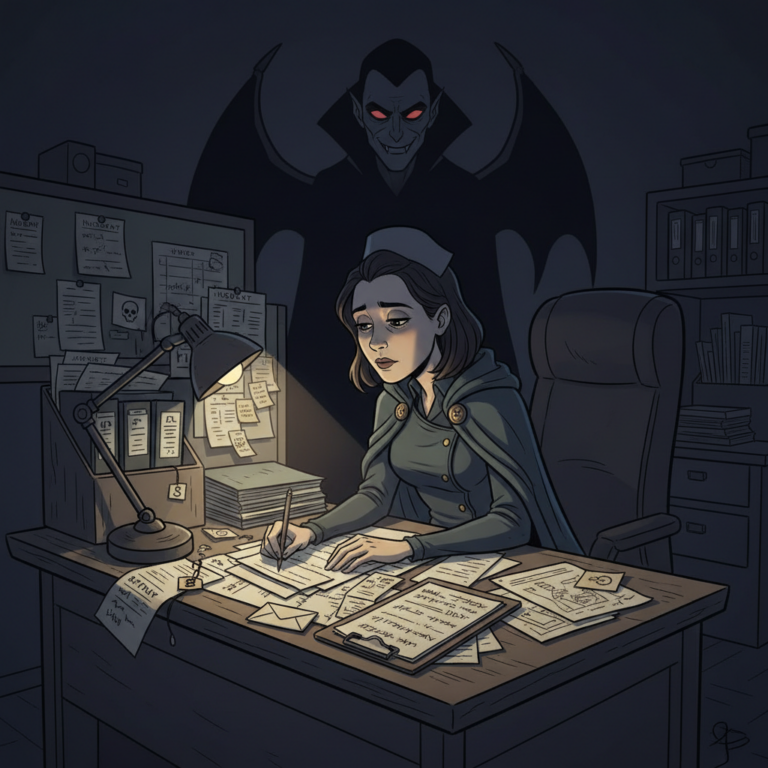
SURVIVING YOUR FIRST NIGHT SHIFT — 9 THINGS NOBODY TELLS YOU
📜 THE FORGOTTEN SCROLLS: CHRONOLOGY OF THE NIGHT WATCH
SURVIVING YOUR FIRST NIGHT SHIFT — 9 THINGS NOBODY TELLS YOU
A dark-humor reality check for newly qualified nurses, students, and daylight idealists before their first Vampire Shift.
When you walk onto a ward for your first night shift, you may arrive with a few romantic ideas.
That everyone will become your new work family.
That patients will be grateful.
That management will finally understand how heroic you are.
That somebody, somewhere, has prepared a beautifully organized plan for the night.
Then midnight arrives.
And the hospital removes the remaining illusions.
The night shift has its own rules. Some are clinical. Some are cultural. And some appear to have been written by a bored demon in the staff room.
You cannot control everything that happens between 8 PM and 8 AM.
But you can lower your expectations enough to protect your sanity.
Here are nine things they forgot to mention in nursing school.
#1. Don’t Expect Everyone to Like You
You arrive at 7:15 PM full of bubbly daytime energy, trying to make friends with the entire crew.
Stop it.
The night shift is a survival matrix, not a social club.
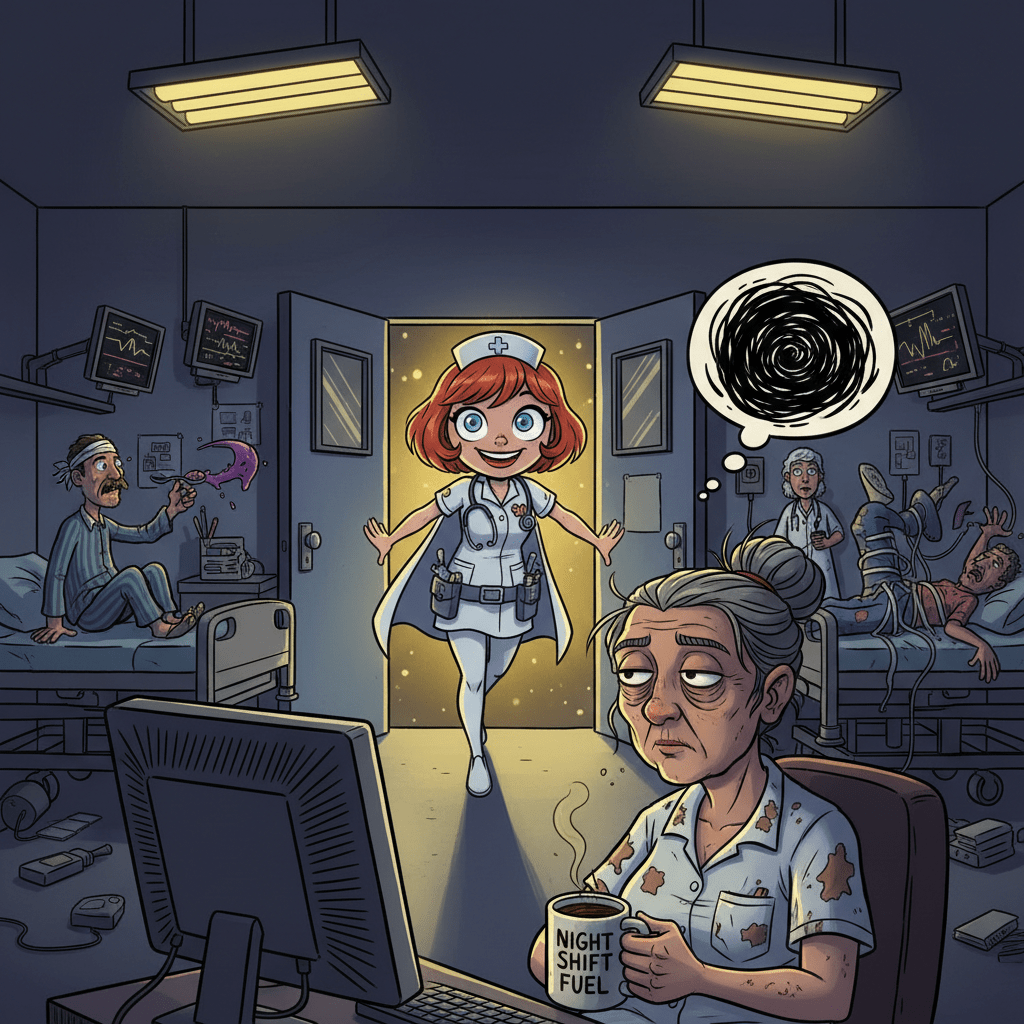
The veteran nurse at the desk has been doing this for years. Her social battery has been sitting somewhere around 0% since approximately 2012, and she does not need to hear about your weekend plans.
And that’s fine.
She doesn’t need to like you. You don’t need to like her. You need to be able to trust each other when something goes wrong.
She needs to know that you are reliable, that you can recognize when a patient is deteriorating, that you communicate clearly, document properly and know what to do when the infusion pump starts screaming at 3 AM.
Respect on the Vampire Shift is usually earned through competence, reliability and teamwork.
Small talk is optional.
Knowing what you’re doing is not.
#2. Don’t Expect People to Change Overnight
You might think that after a brutal night where everything went sideways, someone in daytime management will finally realize the ward is under pressure and send emergency backup.
Maybe.
But don’t build your survival strategy around it.
Hospitals are complicated systems. Staffing problems, workload and organizational culture rarely transform because one particular night was catastrophic.
Meanwhile, you may receive a beautifully formatted email about resilience and mindfulness while Bed 7 is having an entirely different opinion about organizational wellbeing.
Your job is not to personally repair the entire healthcare system before breakfast.
Your job is to care for your patients, work within your scope, communicate concerns, use the resources available to you and get yourself safely home.
You are a nurse.
You are not an infrastructure redevelopment program.
#3. Don’t Expect Approval, Medals, or a Thank-You Email
If you are working nights because you need constant applause and validation from management, you may have selected the wrong profession.
During the day, people see you.
At night, you can feel almost invisible.
You can spend twelve hours dealing with admissions, deterioration, difficult conversations, documentation and whatever fresh nonsense the ward decides to produce at 4 AM.
Then the morning team arrives.
And somebody asks why the folder isn’t perfectly organized.
Welcome back to civilization.
Your sense of professional worth cannot depend entirely on whether somebody senior notices what happened between midnight and sunrise.
Sometimes the reward is much quieter.
You know you noticed something early.
You know you advocated for your patient.
You know you supported your colleague.
You know you got through the night without abandoning your standards.
That counts.
Even if nobody sends you a certificate.
#4. Don’t Expect People to Read Your Mind
This one is simple.
You are exhausted.
Your colleague is exhausted.
The person covering the other side of the ward is also exhausted.
Nobody has the spare neurological capacity to decode your facial expression from twelve meters away.
You can stand beside the medication fridge looking like a Victorian ghost and hope someone notices that you need help.
They might.
They probably won’t.
Use your words.
If your patient is deteriorating, say it.
If you need another pair of hands, ask.
If you are overloaded, communicate it before you reach the point where your brain starts producing smoke.
Something as simple as:
“I need help with Bed 4 now.”
is infinitely more useful than staring into the middle distance and hoping your colleagues develop telepathy.
Communication during the night shift should be clear, direct and respectful.
Think 16G needle.
Sharp.
#5. Don’t Ignore Your Clinical Gut
Now we get into the strange territory.
Every experienced nurse knows the feeling.
You walk into a room.
The observations aren’t necessarily screaming disaster.
The numbers may not yet look dramatic.
But something feels wrong.
The patient looks different.
Their breathing sounds different.
Their color has changed.
Their behavior isn’t quite right.
You can’t immediately explain it, but your internal alarm has started ringing.
Don’t dismiss that feeling.
Clinical intuition isn’t magic, and it should never replace assessment, observations, early warning systems or appropriate escalation.
But it can be an important signal to stop and look again.
Research on nurses’ clinical judgement supports the role of experience, pattern recognition, patient data and teamwork in recognizing deterioration.
So if your gut says:
“Something isn’t right.”
Don’t simply whisper a prayer to the Vampire Shift.
Look again.
Reassess.
Check the patient.
Check the numbers.
Communicate.
Escalate according to your local policy.
Your sixth sense isn’t your highest authority.
It’s the little alarm bell telling you to investigate.
And sometimes that little bell is very, very good at its job.
#6. Don’t Expect the Ward to Care About Your Ego
It’s easy to develop a tiny bit of ego when you’ve survived enough nights to feel like you could run the entire hospital with one hand and a lukewarm coffee in the other.
Then the universe humbles you.
A confused patient throws their midnight jelly directly onto your clean scrubs.
A pump starts screaming.
The printer dies.
Someone falls.
The toilet blocks.
And at 5:02 AM, your carefully organized plan for the remainder of the shift becomes a historical document.
You are an important part of the team.
You are not the entire team.
The best night-shift nurses know when to lead, when to ask for help, when to step back and when to adapt.
Leave the ego in your locker.
Bring the insulated tumbler.
You’re going to need it.
#7. Don’t Expect the Forbidden Words to Go Unpunished
If you’re new to the graveyard shift, learn the ancient language immediately.
There are words you do not say.
You do not say:
“It’s quiet tonight.”
You do not say:
“I hope it stays calm.”
And absolutely do not say:
“We might actually get a break.”
The moment those syllables leave your mouth, something happens.
Three admissions.
Two call bells.
A missing doctor.
A broken printer.
An inexplicable plumbing emergency.
And one patient who has apparently decided that 3:11 AM is the perfect time to completely reinvent their care plan.
The veteran nurses will look at you.
They won’t need to explain.
You have summoned it.
This is not science.
This is hospital folklore.
Respect the folklore.
Keep your mouth shut.
#8. Don’t Expect Coffee to Defeat Biology
Coffee gets blamed for everything on the night shift.
And honestly, coffee has enough problems already.
Caffeine can improve alertness during night work. The problem is using it as a substitute for sleep.
Six enormous cups of industrial-strength breakroom coffee at 3 AM may make you feel temporarily invincible.
Then morning arrives.
Your body is exhausted.
Your brain is buzzing.
You’re lying in bed wondering why you can hear your own heartbeat.
And the sun is laughing through the curtains.
Caffeine can also interfere with the daytime sleep you’re desperately trying to protect, so timing matters.
Use caffeine deliberately.
Don’t turn the coffee machine into an intravenous infusion.
And don’t let the wellness industry convince you that a supplement can replace actual sleep.
If someone invents that product, every nurse I know will buy six.
#9. Don’t Expect Day People to Understand Your World
You try to explain why you’re completely non-functional at 2 PM on a Thursday.
They look concerned.
You explain that you worked twelve hours overnight.
They say:
“Why don’t you just go to bed earlier?”
You stare at them.
They continue:
“I could never sleep during the day.”
Exactly.
That’s the problem.
Night-shift workers are asking their bodies to stay awake when the circadian system is naturally pushing toward sleep, then trying to sleep while the rest of the world is fully operational.
Daytime sleep can be shorter and more easily disrupted, which is one reason protecting the sleep environment matters.
Then the neighbor starts the lawnmower.
The postman rings.
Someone starts drilling through the wall.
A delivery driver calls.
The teenagers need something.
The dog discovers a spiritual crisis.
And suddenly your carefully protected sleep window has become a community event.
Stop expecting people who have never worked nights to instinctively understand it.
Explain what you need.
Protect your sleep.
Build your own support system.
And find the people who don’t need an explanation.
Because somewhere in the dark, another nurse is also lying underneath blackout curtains thinking:
“If that lawnmower starts again, I am becoming a criminal.”
You are not alone.
You have found your people.
🚪 ACCESS THE AIRLOCK: WELCOME TO THE TRUE COVEN
You’ve read the rules.
The romantic version of nursing has officially been buried somewhere behind the medication room.
The Vampire Shift isn’t glamorous.
It’s teamwork.
Fatigue.
Dark corridors.
Clinical judgement.
Bad coffee.
Good colleagues.
Unexpected chaos.
And the strange, dark humor that somehow gets you from 7 PM to 7 AM.
But you don’t have to face it alone.
Before you clock out and walk into the morning light, step through the airlock into The Asylum Sanctuary — our private digital fortress built for frontline night-shift professionals.
Drop the professional filter.
Leave the polished version of nursing at the door.
Share the stories you can only tell people who have actually been there.
The absurd moments.
The difficult nights.
The dark humor.
The things that make absolutely no sense to anyone who has never worked while the rest of the country sleeps.
The Asylum Sanctuary is free, independent and supported by The Owl Nurse.
The hospital can keep the fluorescent lights.
We’ll keep the dark.
Your coven is waiting.
🦉 SPIRITUAL CO-CONSPIRATOR NOTE
Some of the humor and observations behind this piece were inspired by the wider tradition of Polish nursing humor and the work of Polish ICU and anesthetic nurses, including Ania of SrokaO.pl. The Vampire Shift may have different languages, but apparently the night shift speaks fluent sarcasm everywhere.
Note: The Facebook Group is our temporary launch incubator. Our fully private custom platform is under construction right here on the website!