3 AM Corridor Hallucinations
📜 THE FORGOTTEN SCROLLS: Chronology of the Night Watch
SCROLL THREE: 3 AM HOSPITAL CORRIDOR HALLUCINATIONS
When the Coat Rack Starts Looking Suspicious
There comes a moment on every night shift.
Not at the start, when you’re still fueled by optimism and your first coffee.
And not at the very end, when the thought of your bed is the only thing keeping you upright.
It happens in the dead zone.
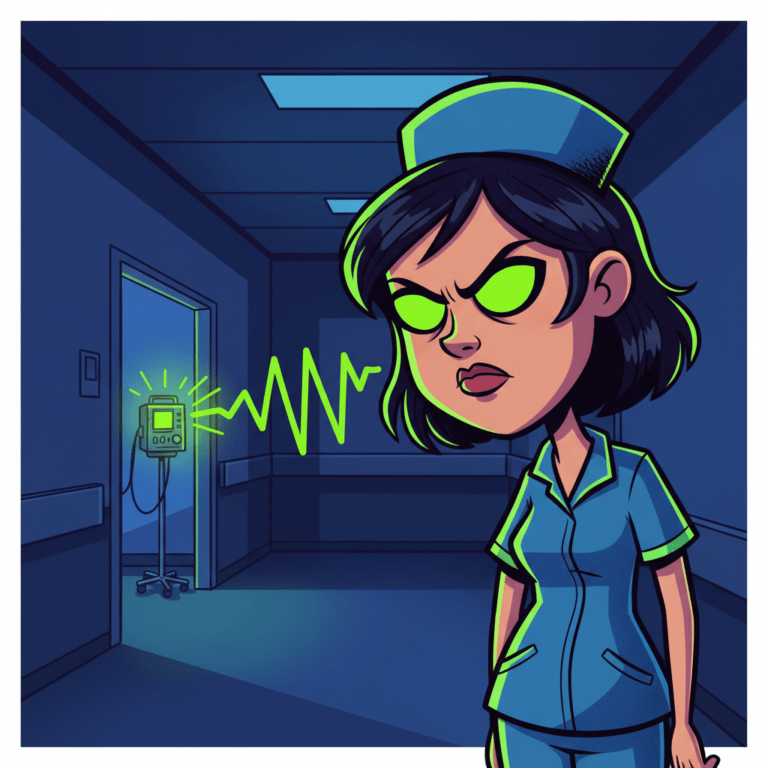
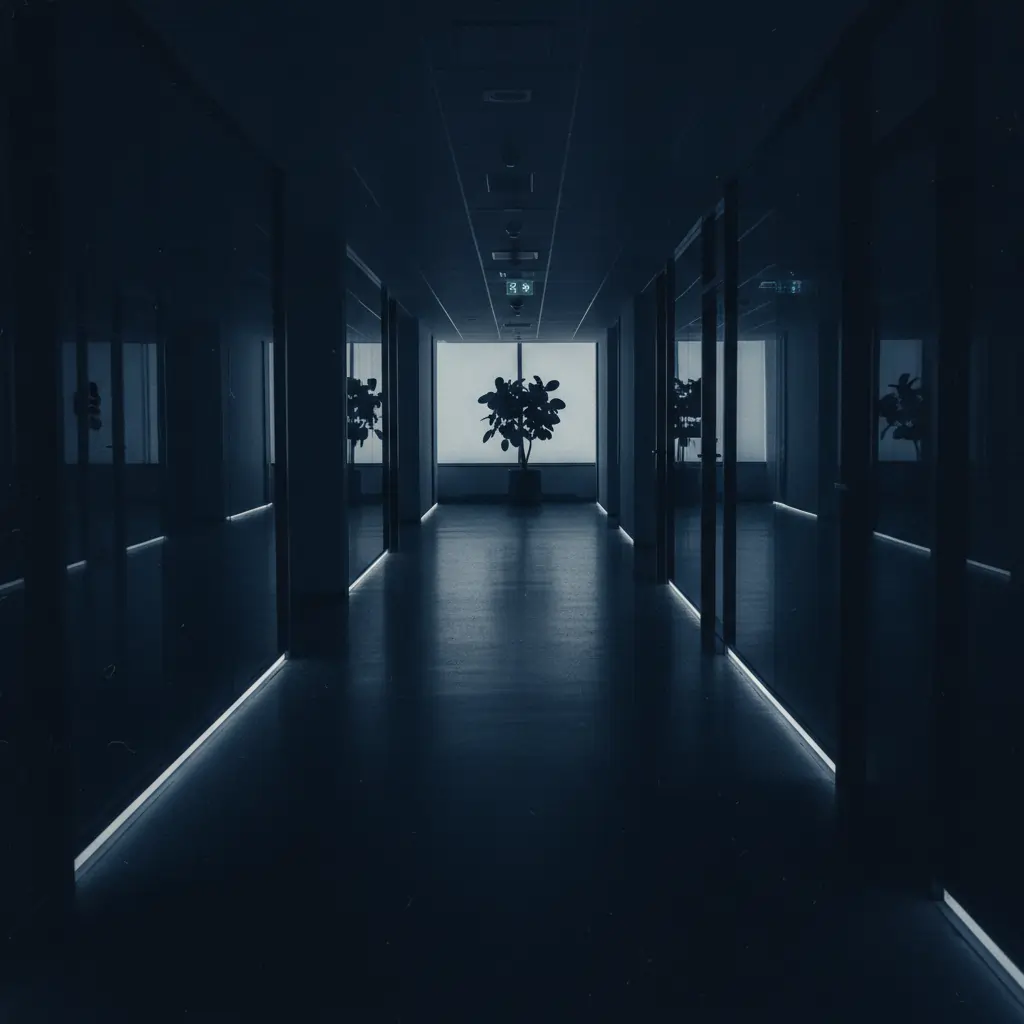
You’re shuffling down the corridor for the 47th time; it’s 3:17 AM, and the ward is deathly quiet.
Suddenly, that coat rack at the end of the hall seems disturbingly human.
You stop.
The coat rack stops.
A classic Western-style standoff ensues.
Five agonizing seconds later, your brain finally registers reality: it’s just the same coat rack that has terrorized every night-shift worker for three years.
You mutter something unprintable under your breath and carry on.
Welcome to the strange world of night-shift visual trickery.
If you’ve ever done a double-take at a shadow that turned out to be an IV pole doing nothing suspicious, you’re not necessarily losing your mind.
You may simply be deep in the sacred delirium of the Vampire Shift.
Sleep deprivation really can affect attention, reaction time and perception. A 2026 systematic review and meta-analysis found that acute total sleep deprivation impairs visual, auditory and audiovisual perception. Earlier research has also documented visual distortions, illusions and hallucinations during severe sleep loss.
So yes.
Sometimes the coat rack really does look suspicious.
Unfortunately, science is not going to arrest it.
🧠 THE BRAIN TRICKERY: IT’S NOT YOU, IT’S YOUR NEURONS
A shadow moves.
A linen trolley briefly resembles an escaped patient.
An IV pole appears to drift toward you like a low-budget horror villain.
Sometimes you swear someone called your name, but the hallway is completely empty.
The human brain is a masterpiece of pattern recognition.
Unfortunately, after hours of overnight work, it can become a little too enthusiastic.
In dim lighting and quiet corridors, your brain has less reliable information to work with. Add fatigue, reduced attention and a nervous system that desperately wants to be asleep, and the brain can start filling in the blanks.
At 3:00 AM, its creative writing department takes over.
And apparently it has decided that the linen trolley is a patient.
Sleep deprivation is associated with perceptual distortions and illusions, and in more severe or prolonged sleep loss, hallucinations can occur. Visual experiences appear to be particularly common in the literature.
Clinical psychologist and sleep specialist Dr. Michael Breus has also discussed microsleeps as brief periods in which parts of the brain can temporarily enter a sleep-like state during wakefulness when someone is severely fatigued.
That doesn’t mean every suspicious coat rack is a microsleep.
It does mean that when you’re profoundly tired, your brain is not processing the world with the same precision it has after a proper night’s sleep.
Which is slightly inconvenient when the world contains approximately fourteen thousand identical hospital objects designed specifically to look like something else in poor lighting.
⚰️ THE SHARED DELIRIUM
The best part?
You are not alone in this horror movie.
Walk into the staff room, confess your “murderous coat rack incident,” and your fellow vampires will immediately chime in:
- “I apologized to a hand-sanitizer dispenser.”
- “I thought a crash cart was actively stalking me down the hall.”
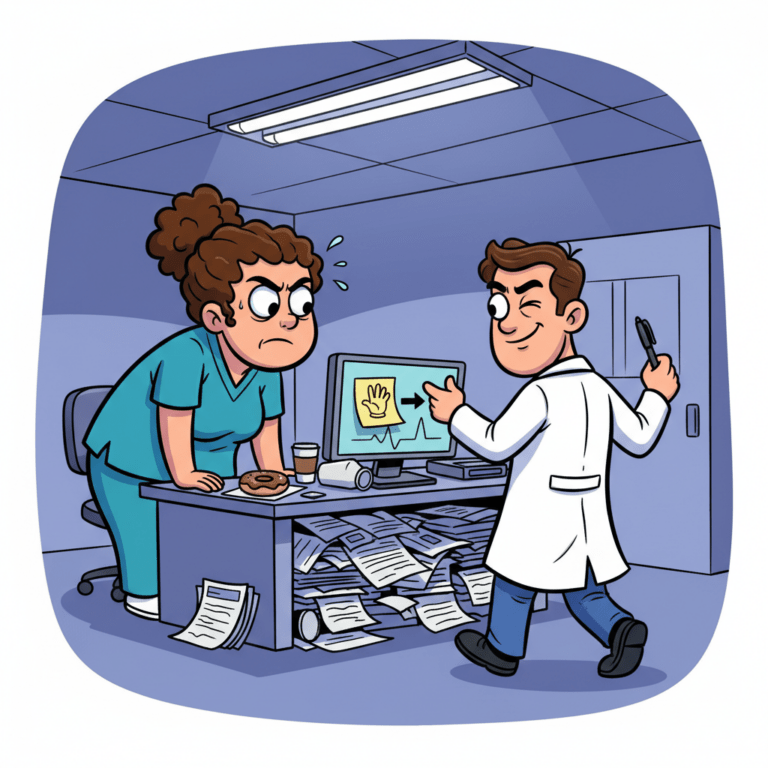
- “I waved at a CPR mannequin because I thought it was a new registrar.”
These moments become hospital folklore.
Years later, no one remembers the paperwork.
But everyone remembers the night you tried to chart a pulse on a cleaning trolley.
That is the strange social glue of the night shift.
You see something ridiculous.
You briefly question your sanity.
You tell another nurse.
They look at you for approximately two seconds.
Then they say:
“Yeah. That coat rack does that.”
And suddenly you’re fine.
Mostly.
🔬 WHY DOES THIS HAPPEN?
The scientific explanation is far less exciting than the ghost-story version.
Sleep deprivation has documented effects on attention, reaction time, sensory processing and perception. The newest systematic review I found, published in 2026, analyzed 56 independent studies and found that acute total sleep deprivation impaired perceptual accuracy and slowed perceptual reaction times across visual, auditory and audiovisual tasks.
A separate systematic review of severe sleep deprivation found that perceptual distortions and hallucinations could occur after prolonged sleep loss, with visual experiences being the most consistently affected. The researchers reported experiences ranging from simple visual distortions and illusions to more complex hallucinations.
So the basic idea behind the coat rack is not completely ridiculous.
Your brain is constantly trying to interpret incomplete sensory information.
When fatigue starts interfering with attention and perception, the interpretation can become less reliable.
A suspicious-looking coat rack suddenly becomes the hospital’s most threatening employee.
And honestly?
It has seniority.
🛡️ FIGHTING BRAIN FOG WITHOUT THREATENING YOUR SLEEP
Most night-shift workers respond to 3:00 AM brain fog the exact same way:
Coffee.
Then more coffee.
Then coffee’s aggressive cousin:
the energy drink that tastes like liquid battery acid.
But there is a problem.
Caffeine can improve alertness during night work, but if you use it too close to your intended daytime sleep, it can make that sleep harder to obtain. Guidance on shift work therefore generally recommends thinking about when you use caffeine, rather than simply treating it as an unlimited night-shift fuel supply.
So if you’re drinking a triple espresso at 4:00 AM and then wondering at 10:30 AM why your brain has apparently rejected the concept of sleep…
the coffee may be part of the conspiracy.
You get home.
The sun is up.
Your body is exhausted.
Your brain is still vibrating.
Welcome to the ultimate shift-worker curse:
tired but wired.
THE MEDIUM-CHAIN TRIGLYCERIDE (MCT) PROTOCOL
This is where the original article went a little too far into supplement territory, so I am keeping the MCT discussion but making the science honest.
MCTs are rapidly metabolized fats that can increase ketone production, providing the brain with an alternative fuel source. There is growing research into whether ketones can influence cognitive performance, and recent systematic-review evidence suggests that exogenous ketone supplementation may produce modest improvements in cognitive performance. However, the evidence is heterogeneous, and that does not mean that MCT oil has been proven to prevent night-shift brain fog or replace sleep.
So, if MCT oil is part of your nutritional routine, think of it as nutrition, not a neurological force field.
Because sadly:
MCT oil cannot make the coat rack less suspicious.
TARGETED B-VITAMIN INFRASTRUCTURE
B vitamins are important nutrients involved in normal energy metabolism and nervous-system function.
Thiamine, or vitamin B1, is particularly important for the nervous system, and severe deficiency can produce significant neurological and cognitive problems.
But let’s keep this one sensible too.
A B-complex supplement is not a magic switch that turns a sleep-deprived brain into a perfectly functioning night-shift supercomputer.
If you are deficient, correcting that deficiency matters.
If you are not deficient, more is not automatically better.
Your bloodstream is not a nightclub.
It does not need every B vitamin on the guest list.
NON-STIMULANT ALERTNESS STRATEGIES
If you want to support alertness without simply throwing more caffeine at the problem, there are other strategies worth considering.
A planned nap before a night shift can improve alertness, and short planned naps during night work can also be useful when workplace policy and patient safety allow them. NIOSH guidance for nurses specifically discusses planned napping as a fatigue countermeasure.
There is one important catch:
Do not wake up from a nap and immediately sprint into a critical clinical task.
Sleep inertia can temporarily impair reaction time, memory and thinking after waking, particularly when you are already sleep deprived. Allowing some recovery time before safety-critical activity is important.
Cold-water exposure and other alertness techniques are popular among shift workers, but I would not present them as proven treatments for night-shift brain fog.
Sometimes the most evidence-based strategy is still painfully boring:
sleep.
No supplement can truly replace it.
If someone invents that, every healthcare worker in Ireland will become an instant customer.
I know I would.
🩸 THE REAL NIGHT-SHIFT PROBLEM
There is a darker side to these funny little hallucination stories.
A coat rack looking human is funny.
A shadow looking like an IV pole is funny.
Apologizing to a hand-sanitizer dispenser is going to become staff-room folklore.
But significant sleep deprivation can impair perception, attention and performance — and in healthcare, that matters.
The goal isn’t to frighten night workers.
It is to recognize the difference between:
“That coat rack looked weird for a second.”
and:
“I am so exhausted that I am struggling to function safely.”
Those are not the same thing.
If excessive sleepiness, perceptual disturbances, concentration problems or difficulty functioning are becoming persistent, it is worth taking them seriously and discussing them with an appropriate healthcare professional or occupational-health service.
Because being tough is not the same thing as being invincible.
And the hospital doesn’t need you to prove your loyalty by becoming a hallucinating vampire.
It has enough problems already.
🚪 ACCESS THE AIRLOCK: THE COVEN IS WAITING
The next time you’re aggressively staring down a shadowed object suspiciously at 3:00 AM, take a breath.
You aren’t necessarily going crazy.
You may simply be a tired vampire doing vital, life-saving work in a world built for day people.
Stay hydrated.
Protect your sleep.
Use caffeine strategically.
And if the IV pole starts moving again…
maybe blink twice before sounding the alarm.
Don’t carry the weight of the graveyard shift alone.
Step through the airlock into The Asylum Sanctuary — our private, deliberately moderated digital space for night-shift staff.
Drop the professional filter.
Join our coven.
Share the raw trench stories.
Share the ridiculous moments.
Share the pitch-black clinical humor that somehow keeps us sane when the rest of the world is asleep.
The Sanctuary is free to join and designed to remain independent from corporate advertising. The Owl Nurse helps support the work behind it.
No corporate wellness slogans.
No pretending the night shift is glamorous.
Just people who understand what happens after midnight.
Because sometimes the best therapy after a 3:17 AM confrontation with a coat rack is finding another nurse who says:
“Yeah. That happened to me too.”
Your coven is waiting.
🦉 A NOTE FROM THE NIGHT WARDEN
This Scroll is an educational and personal account of night-shift experiences, sleep deprivation and fatigue. It is not intended to diagnose, treat or cure hallucinations, sleep disorders or any other medical condition.
If perceptual disturbances, excessive sleepiness, confusion, mood changes or difficulty functioning are persistent or affecting your ability to work safely, seek appropriate medical advice.
And if you are using supplements such as MCT oil or B-complex products, remember that supplements are not substitutes for adequate sleep or professional medical care.
Because the coat rack may be innocent.
Your sleep deprivation is not.
Note: The Facebook Group is our temporary launch incubator. Our fully private custom platform is under construction right here on the website!