UNWRITTEN NURSING DICTIONARY — VAMPIRE SHIFT EDITION
📜 THE FORGOTTEN SCROLLS: Chronology of the Night Watch
THE UNWRITTEN NURSING DICTIONARY — VAMPIRE SHIFT EDITION
What nurses actually mean when the night shift takes over.
WARNING:
This dictionary is not intended for civilians.
If you understand every entry, I’m afraid you’re already one of us.
Let’s be entirely honest for a second.
When you spend 12 hours under fluorescent lighting, surviving on cold espresso and professional optimism that should probably have been declared missing years ago, standard human language starts to malfunction.
Words are still being spoken.
They just don’t necessarily mean what the outside world thinks they mean.
On the night shift, language becomes a survival mechanism. It protects your boundaries, your sanity, your clinical focus, and occasionally the last remaining fragment of your soul.
To the outside world, we sound polite, structured and completely in control.
Underneath the professional mask, however, there is an unwritten graveyard dictionary.
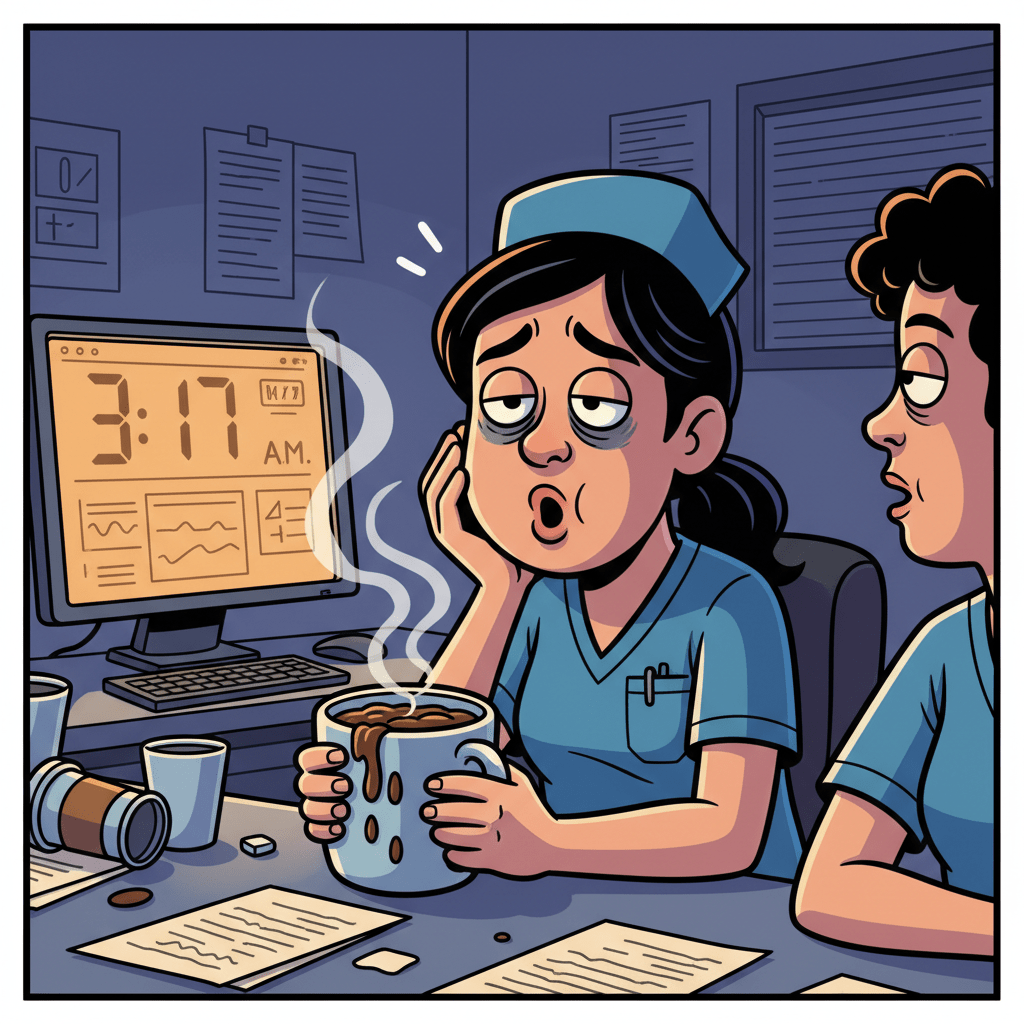
If you’re reading this at 3:17 AM while sitting on an upside-down supply bucket in a dark utility room, congratulations.
You already speak fluent Vampire Shift.
Here is what we actually mean when the night takes over:
- “I’ll be with you in a minute.”
Translation: Time no longer exists. One minute, one hour, one geological era — all perfectly possible. My physical body is currently trapped somewhere between 3:00 AM and yesterday. - “Just a quick question.”
Translation: Welcome to your new side quest. Congratulations. You will not be leaving this room before sunrise. Prepare to fight a frozen iPad and a medical mystery nobody ordered. - “The patient is stable.”
Translation: Do not say that out loud. Don’t look at the monitor. Don’t look at me. Don’t tempt the universe. The second those words leave your mouth, the call bell will begin screaming and somebody will suddenly need a doctor. - “I’m going for my break.”
Translation: If you see me, no you didn’t. For the next 20 minutes I am a civilian. I have never seen a syringe. I have no idea what a drug round is. I have left this earthly plane. - “Can you just…”
Translation: You have been selected for another side quest. There is no prize. It is never actually “just” one thing. Somewhere inside this sentence is a patient transfer, a missing hoist and a lift that has mysteriously stopped working. - “It’s been quiet tonight.”
Translation: Why did you say that? Why? You have just summoned the entire hospital pantheon. Start counting down to the next admission. - “Do you have a second?”
Translation: I need you for the next 20 minutes. Possibly longer. There is a reasonable chance we will also be lifting something heavy. - “He’s a walkie-talkie.”
Translation: At least one patient can get themselves to the bathroom and back without requiring a three-person expedition. A small miracle in the middle of the night. - “She’s a total.”
Translation: Level 99 boss fight. Do not approach without full buffs, adequate staffing and a strategic supply of disposable pads. - “I’ll chart it later.”
Translation: Dangerous words. Possibly famous last words. I have absolutely every intention of doing it later. Whether later actually exists is another matter. - “I’m fine.”
Translation: I am somewhere between crying, laughing and staring blankly at the wall. Please choose whichever version causes the least paperwork. - “Let me grab the doctor.”
Translation: I am about to disappear down a corridor and return with the information that the doctor is on another floor, another ward, or possibly another dimension. - “He’s a frequent flyer.”
Translation: This patient knows the ward, the door codes, the usual delays and possibly the stockroom situation better than half the new staff. - “I’ll check the labs.”
Translation: I will open the computer, stare into the black void of the hospital system, wait for it to load, forget why I opened it, and eventually go make another coffee. - “We need to keep an eye on him.”
Translation: Something about this situation is making my clinical instincts uncomfortable. I’m not predicting disaster. I’m just not taking my eyes off the patient. - “I’ll call you back.”
Translation: I genuinely intend to. The hospital has other plans. - “Let’s cluster care.”
Translation: Let’s try to do everything at once so we don’t have to keep disturbing the patient. We will then return approximately eight minutes later because something is beeping. - “I’m almost done with my notes.”
Translation: I have written the date. Possibly the patient’s name. Spiritually, I am finished. - “Do you want a hand?”
Translation: My back hurts. Your back hurts. We both know this is about to become a two-person operation. Let’s just get it done before one of us develops a new career in orthopedics. - “He’s a bit tachy.”
Translation: That monitor has been yelling at me for ten minutes and I am pretending it is ambient music while I assess what is actually happening. - “I’ll grab some supplies.”
Translation: I am going to the stockroom, which is currently the closest thing we have to a witness-protection programme. - “Let’s page respiratory.”
Translation: Let’s bring another qualified human being into this particular disaster so we can solve it together. - “I’ll be right back.”
- Translation: I have entered the corridor and may not return before handover.
THE NIGHT-SHIFT SUBTEXT
The funniest part is that none of this is really about the words.
It’s about context.
A tired nurse saying “Do you have a second?” can mean anything from “Can you help me reposition this patient?” to “I have just noticed something I absolutely do not want to deal with alone.”
And sometimes the smallest sentence carries the biggest message.
“Can you look at this?”
That one deserves its own warning label.
Because when a colleague who has worked the ward for twenty years quietly says:
“Can you look at this?”
You look.
You don’t finish your coffee.
You don’t say, “Give me five minutes.”
You look.
Night-shift communication is often short because nobody has the energy for a TED Talk at 4:00 AM.
And that’s not necessarily a bad thing.
Clear communication, teamwork and structured information-sharing are important parts of patient safety, particularly in high-pressure healthcare environments. Research suggests that effective teamwork and communication can support safer care, although the strength of the evidence varies between settings and studies.
Night work can also bring fatigue and reduced alertness. Research in nurses has associated fatigue with poorer performance and patient-safety outcomes, although studies differ in how fatigue and its effects are measured.
So yes.
Sometimes the sarcasm is just sarcasm.
But sometimes:
“Do you have a second?”
means:
Please come here. I need another pair of eyes.
And every experienced nurse knows the difference.
THE UNWRITTEN RULE
We don’t wear capes.
We wear scrubs.
We carry pens that mysteriously disappear.
We have dark circles under our eyes that have effectively become permanent facial architecture.
And we keep people safe while most of the city is asleep.
The night shift has its own language because it has its own culture.
You learn it slowly.
Usually somewhere around your third consecutive night, when somebody says:
“It’s been quiet.”
And you immediately turn around and whisper:
“Take it back.”
Because every vampire knows better.
🚪 ACCESS THE AIRLOCK: EXPAND THE DICTIONARY
The next time you’re standing at the nurses’ station pretending to check an offline computer system because you need thirty seconds without anyone asking you for something, look around.
Your colleagues probably understand exactly what you’re doing.
No explanation required.
That’s the strange comfort of the night shift.
You can spend twelve hours surrounded by people and still communicate with a raised eyebrow, a sigh and one carefully selected word:
“Coffee?”
Sometimes that’s enough.
But now I want to build the dictionary with you.
THE SCROLL ENDS HERE. THE CONVERSATION DOESN’T.
What is the one phrase your ward uses that outsiders would completely misunderstand?
Write it like this:
Phrase: “It’s been quiet.”
Night-shift translation: “Prepare for absolute chaos.”
Or give us your own.
One phrase.
One translation.
One tiny piece of the language that only people who have survived the graveyard shift will understand.
Irish nurses. UK nurses. International nurses. HCAs. Doctors. Allied health staff.
Bring your local version.
Because I suspect every hospital has its own secret vocabulary.
And I want to know yours.
The Vampire Shift has its own language.
Let’s write the dictionary together.
🔒 Continue the conversation inside The Asylum Sanctuary.
This is where the stories, confessions, dark humor and conversations continue — behind the gates, among the people who actually understand the shift.
The Scroll ends here.
The gates are open. 🩸🦉
Note: The Facebook Group is our temporary launch incubator. Our fully private custom platform is under construction right here on the website!