The Psychological Madness Of Daytime Lawnmowers

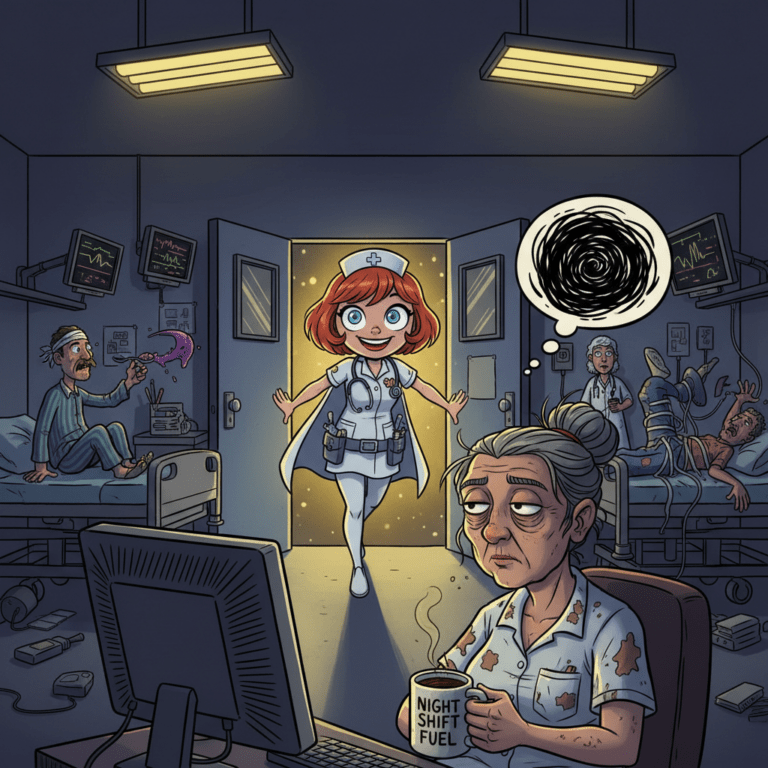
📜 THE FORGOTTEN SCROLLS: Chronology of the Night Watch
THE PSYCHOLOGICAL MADNESS OF DAYTIME LAWN-MOWERS
And Trying to Sleep at 2 PM
It is 1:14 PM on a Tuesday in Dublin.
The sun is actually shining — a rare Irish miracle that should normally be celebrated with a Flake in a 99 cone.
Except you just finished a grueling twelve-hour night shift on the ward, and that beautiful, cursed sunshine is currently piercing through your blackout curtains like a laser beam.
You are trapped in that delicate, volatile state of exhaustion where your eyelids feel like sandpaper, yet your brain is vibrating at a frequency that allows you to hear colors.
You finally drift off.
You are floating.
You are finally at peace.
Then it happens.
Your neighbor, Seamus, decides today is the historic day he must absolutely annihilate his back garden grass.
It’s not just a lawnmower.
It’s a personal declaration of war against your sanity.
The low-frequency rumble vibrates directly through your mattress, syncing perfectly with your caffeine-induced heart palpitations.
And suddenly, you are no longer sleeping.
You are negotiating with Satan.
🔪 THE PRIMAL RAGE OF THE 2 PM WAKE-UP CALL
Your healthcare degree absolutely did not prepare you for the raw, primal rage of hearing a petrol mower at two o’clock in the afternoon.
You lie there, staring blindly at the ceiling, actively calculating the legal definitions of justifiable lawnmower sabotage under Irish law.
You start plotting.
Maybe you’ll hide his tractor.
Maybe you’ll accidentally drop a box of rogue stones over his wall.
Maybe you’ll simply stare at the ceiling and imagine yourself living somewhere without neighbors.
The psychological madness of daytime sleep is deeply real.
The rest of Ireland is having a grand old time drinking tea in the sunshine, while you are lying in the dark manifesting a localized thunderstorm just to rain on Seamus’s afternoon.
And unfortunately, this part isn’t just vampire theatre.
Daytime sleep is often shorter, lighter and more easily disrupted by light, noise and temperature than sleep taken at night. Shift-worker guidance specifically recommends making the sleep environment as dark, quiet and cool as possible.
So when you are lying there thinking:
“Why can’t I just sleep?”
The answer may not be a lack of discipline.
Your biology is receiving a very loud message that says:
IT IS DAYTIME. WAKE UP.
And Seamus is apparently helping.
🛡️ THE SHIFT-WORKER’S COUNTER-ATTACK: HOW TO DEFEND YOUR DAYTIME SLEEP
When Seamus refuses to run out of petrol, you cannot just lie there allowing yourself to become progressively more furious before your next shift.
You need a calm, strategic approach to help your nervous system wind down and protect whatever sleep opportunity you’ve managed to create.
The good news is that some of the most useful strategies are gloriously boring.
Which is unfortunate.
But effective.
1. BUILD THE PERFECT CRYPT
If you want your brain to believe it is nighttime, make your bedroom look like nighttime.
Your bedroom needs to be so dark that Batman would feel comfortable hosting a meeting there.
Blackout Curtains: Close them properly and minimize gaps around the edges.
The Eye Mask: If daylight is still getting through, a comfortable eye mask can provide another layer of darkness.
The Temperature: Keep the room comfortably cool rather than excessively warm. Cooler conditions can support better sleep.
The Noise: Use earplugs, white noise, a fan or another consistent background sound if daytime activity is disturbing you.
These aren’t glamorous interventions.
Nobody is going to make a Netflix documentary called:
“The Woman Who Bought Better Blackout Curtains.”
But they can make a real difference.
HSE guidance for shift workers specifically recommends heavy curtains, blackout blinds or eye shades, reducing phone interruptions, asking household members and neighbors to keep noise down, and using earplugs or white noise when necessary.
2. THE SEAMUS PROTOCOL: CONTROL THE NOISE
Sometimes the problem isn’t your bedroom.
It’s the civilization happening outside it.
If you know that the neighbor’s lawnmower, building work, traffic or children’s football tournament is likely to wake you, don’t wait until you’re already furious to think about it.
Build the defense in advance.
Earplugs.
White noise.
A fan.
Closed windows where practical.
And, if you have a reasonable relationship with your neighbors, a polite conversation can sometimes achieve more than lying in bed fantasizing about medieval revenge.
“I’m working nights and usually sleeping around this time. Would you mind avoiding the loudest garden work during those hours when possible?”
Look at you.
Using communication instead of hiding a tractor.
Personal growth.
Daytime sleep guidance from the HSE specifically recommends discussing work patterns with close neighbors and asking them to avoid noisy activities during your sleep period where possible.
3. MUZZLE THE MIND-RACING
This is where the original version went a little too far with the science.
There is no good reason to tell a tired nurse that magnesium is going to magically switch off panic while Seamus is operating heavy machinery outside.
But the underlying problem is real.
You can be physically exhausted while your brain remains highly alert after a demanding night shift.
A predictable wind-down routine can help create a transition between clinical alertness and sleep mode.
Try:
- a warm shower;
- dimmer light;
- quiet music or reading;
- avoiding stressful conversations;
- reducing unnecessary phone use;
- keeping your post-shift routine predictable.
The Irish government’s Healthy Ireland guidance also recommends a wind-down routine, limiting screens before sleep, keeping the bedroom dark and quiet, and using a warm shower as part of preparing for sleep.
In other words:
Don’t go directly from:
“PATIENT DETERIORATING — MOVE.”
to:
“WHY AM I NOT ASLEEP?”
Give the nervous system a transition.
It has had a night.
4. WHAT ABOUT MAGNESIUM?
Now we arrive at the supplement cupboard.
Because apparently every sleep article eventually ends up here.
Andrew Huberman has discussed magnesium threonate and magnesium bisglycinate in the context of sleep and has discussed possible mechanisms involving GABA signaling.
But here’s the important part:
That is not the same thing as proving that magnesium will fix daytime sleep for every night-shift worker.
In fact, Matthew Walker has pointed out that the overall evidence for magnesium supplementation improving sleep is not particularly strong in healthy people who aren’t deficient, although there is some evidence of benefit in specific populations.
So if you are considering magnesium, think of it as one possible part of a wider routine, not a neurological emergency button.
And please don’t turn the sentence:
“Magnesium may help.”
into:
“MAGNESIUM WILL DEFEAT SEAMUS.”
That is how marketing departments are born.
5. RESET YOUR INTERNAL BIOLOGICAL CLOCK
Your brain uses light as one of its major timing signals.
That is why bright daylight immediately after a night shift can be unhelpful when you’re trying to convince your body that it is bedtime.
Reducing bright-light exposure on the journey home, keeping the bedroom dark and maintaining a reasonably consistent sleep schedule can all help support daytime sleep.
Shift-worker guidance recommends developing a suitable sleep schedule and, where possible, keeping it reasonably consistent.
You don’t have to become a laboratory experiment.
You simply need to stop giving your brain conflicting instructions.
Outside:
SUNSHINE! MORNING! WAKE UP!
Bedroom:
PLEASE SLEEP.
Your brain:
“Could you people agree on something?”
6. THE CAFFEINE TRAP
When Seamus wakes you at 2 PM and your next twelve-hour shift starts in a few hours, the obvious solution appears to be:
COFFEE.
Then another coffee.
Then the emergency coffee.
Then the coffee you drink while making the coffee.
But caffeine timing matters.
Caffeine can help alertness during night work, but consuming it too close to your intended sleep period can make it harder to fall asleep later.
There isn’t one magical caffeine cut-off time that works for every night worker because sensitivity and metabolism vary.
But if you repeatedly arrive home exhausted and then discover that your brain has apparently booked itself into a conference until noon…
look at the caffeine.
Sometimes the villain isn’t Seamus.
Sometimes it’s the third espresso.
7. PROGRESSIVE MUSCLE RELAXATION: STOP SLEEPING LIKE A CORPSE
There is a particular form of daytime sleep frustration where you are lying perfectly still while every muscle in your body remains clenched in rage.
Jaw.
Shoulders.
Neck.
Hands.
Everything.
Progressive muscle relaxation and slow breathing can be useful ways of deliberately reducing physical tension before sleep.
The goal isn’t to force yourself unconscious.
The goal is to stop actively fighting your mattress.
You don’t need to become a meditation monk.
You just need to stop lying there like you’re preparing for hand-to-hand combat with the duvet.
🧛♀️ THE REAL NIGHT-SHIFT PROBLEM
The problem with daytime sleep isn’t simply that the sun is annoying.
It is that night workers are trying to sleep at exactly the time when the external environment is encouraging wakefulness.
Light.
Noise.
Traffic.
Deliveries.
Children.
Dogs.
Builders.
Lawnmowers.
Seamus.
And meanwhile, your circadian system is still trying to maintain its own schedule.
This is why daytime sleep deserves to be treated as real recovery, not an optional luxury.
HSE guidance specifically notes that daytime sleep is often lighter, shorter and more easily disturbed than night-time sleep for shift workers.
So if you need blackout curtains, earplugs, an eye mask, white noise and a phone that behaves like it has been confiscated by the state…
use them.
You are not being dramatic.
You’re trying to sleep in the middle of everyone else’s day.
🚪 ACCESS THE AIRLOCK: YOU ARE NOT ALONE IN THE DARK
To all the survivors of the daytime lawnmower brigade:
stay strong.
Your next 12-hour shift starts in less than six hours.
You don’t have to lie there staring at the ceiling alone, fuming in silence.
Step through the airlock into The Asylum Sanctuary — our private, deliberately moderated digital space built for night-shift workers.
Drop the professional filter.
Join your coven.
Share the pitch-black clinical humor that keeps us sane while the daytime world drives us mad.
Share the stories that make absolutely no sense to anyone who has never worked at 3 AM.
Share the strategies that actually help.
The Sanctuary is free to join and designed to remain independent from corporate advertising. The Owl Nurse helps support the work behind it.
No corporate wellness email telling you to “practice mindfulness” while someone outside is attacking a lawn with a petrol engine.
No pretending daytime sleep is easy.
No pretending night work is glamorous.
Just people who understand.
And if Seamus starts the lawnmower again tomorrow?
You know what to do.
Blackout curtains.
Earplugs.
White noise.
Deep breath.
And absolutely no tractor sabotage.
Probably.
Your coven is waiting.
🦉 A NOTE FROM THE NIGHT WARDEN
This article is an educational and personal account of daytime sleep challenges experienced by night-shift workers. It is not intended to diagnose or treat insomnia, shift work disorder or any other medical condition.
If persistent sleep problems or excessive sleepiness are affecting your health, daily life or ability to work safely, speak with an appropriate healthcare professional or occupational-health service.
And remember:
You don’t have to earn your sleep.
If you worked through the night, sleeping during the day is not laziness.
It is recovery.
Note: The Facebook Group is our temporary launch incubator. Our fully private custom platform is under construction right here on the website!