The Nurse Survival Instinct: 15 Things Your Brain Learns After Enough Shifts
📜 THE FORGOTTEN SCROLLS: Chronology of the Night Watch
🖤 THE NURSE SURVIVAL INSTINCT
15 Things Your Brain Learns After Enough Shifts
Let’s be honest for a second.
Nursing school taught us a lot of things. We learned the Krebs cycle — which we have somehow carried around in our brains for years without anyone explaining why — how to chart until our retinas burn, and how to look completely professional while a patient is actively trying to bite our arm.
But nobody warned us about the mutation.
After enough shifts, something changes.
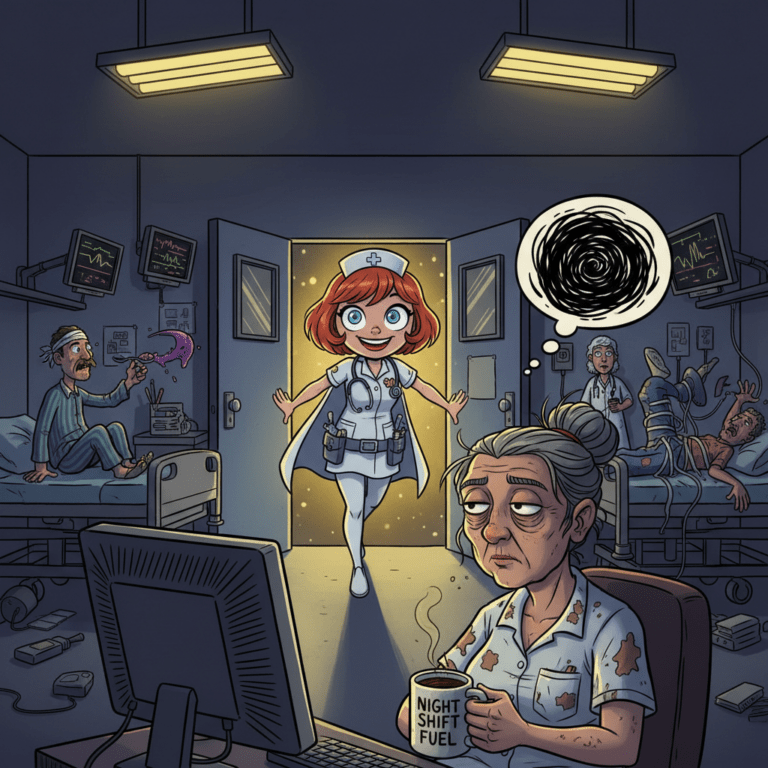
Especially after enough long nights, broken sleep, fluorescent lighting, alarms, call bells and those mysterious 4:00 AM moments when the entire ward seems to have collectively lost its mind.
You start noticing things.
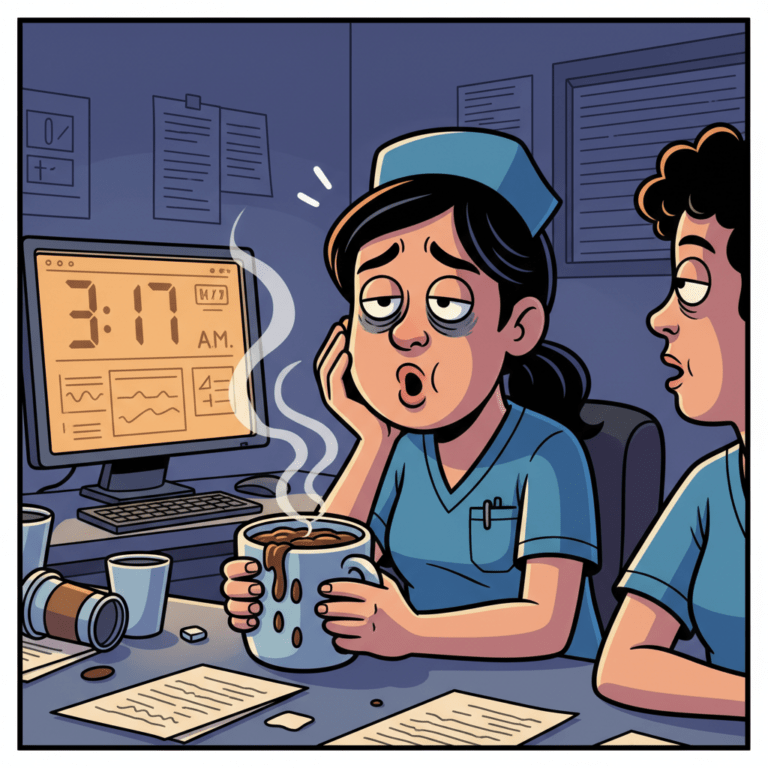
Not necessarily supernatural things. Although, at 3:17 AM, the coat rack remains under investigation.
Your brain becomes extremely good at identifying certain sounds, movements, patterns and tiny changes in the environment. Some of this is simply experience and repeated exposure. Some of what you notice is also shaped by fatigue. And some of it is just the strange psychological adaptation that happens when you spend thousands of hours working in a high-pressure environment.
Science has names for parts of this: vigilance, pattern recognition, fatigue and adaptation to repeated clinical stimuli.
We call it:
The Vampire Shift.
And if you’ve spent enough time on the floor, your brain has probably developed at least a few of these slightly terrifying survival skills.
👂 Part 1: The Predator Senses
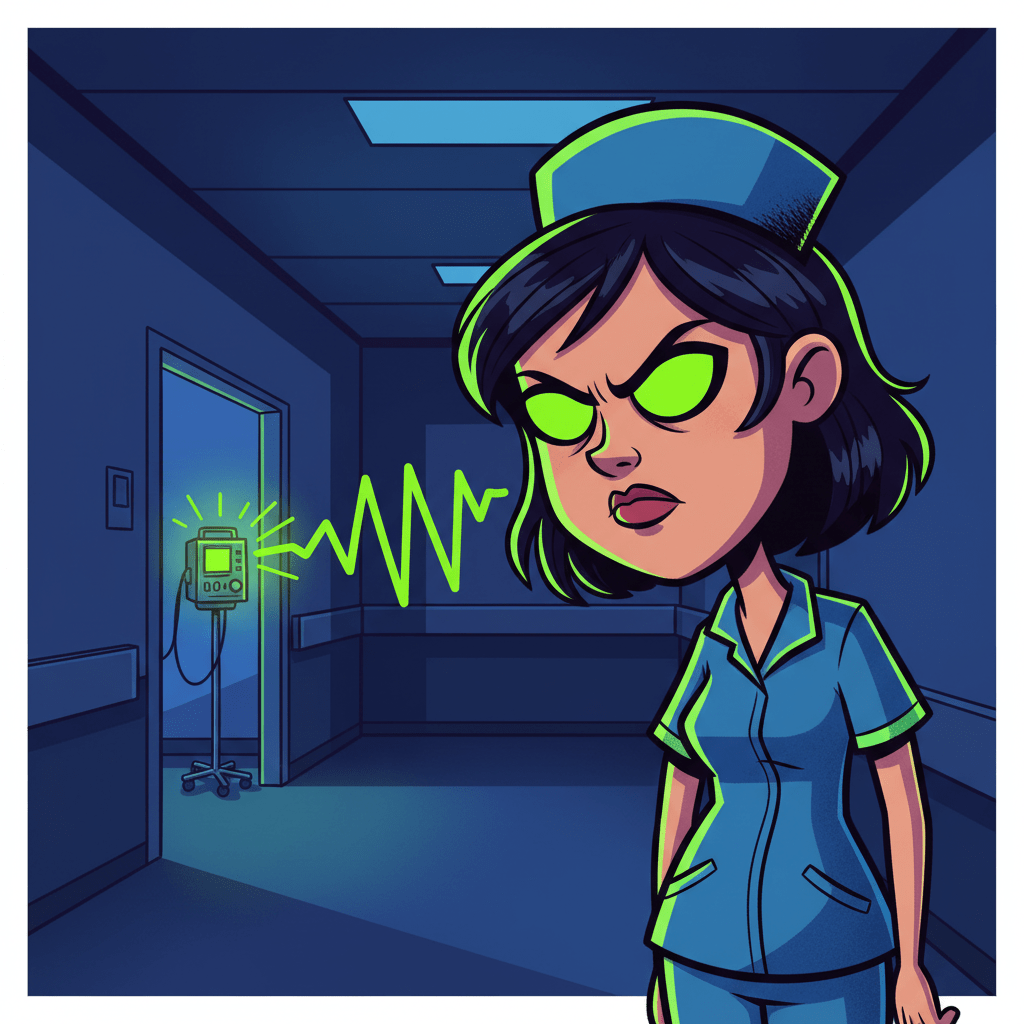
1. The Ultrasonic Pump Sonar
You can hear an infusion pump from three rooms away.
Not just a pump.
That pump.
Through a closed door. Over conversations. Through the general mechanical soundtrack of a hospital at 3:00 AM.
Beep.
Your brain immediately goes:
Occlusion.
Empty bag.
Something has happened.
Go.
This isn’t literally dolphin echolocation, unfortunately.
But repeated exposure to clinical alarms can make nurses highly familiar with different alarm sounds and patterns. Alarm fatigue is a genuine patient-safety issue, and research involving nurses has found that frequent alarms can disrupt attention and clinical work.
Normal people hear:
beep beep beep.
You hear:
somebody’s pump is about to ruin my next twelve minutes.
2. The Footstep Radar
Your brain eventually starts recognizing people before you see them.
You know the footsteps.
The pace.
The shoes.
The particular rhythm of somebody walking down the corridor at 4:00 AM.
You can distinguish the slow, uncertain shuffle of someone new from the confident stride of someone who has been doing this long enough to know exactly where everything is.
And then there is the unmistakable sound of the person approaching with a clipboard.
You don’t even need to turn around.
Your nervous system has already filed the paperwork.
3. The Telepathic Anticipation
You look at a patient.
They look at you.
There is a pause.
You already know.
“Can I have some water?”
Or:
“Could I have another pillow?”
Or:
“Sorry, nurse…”
You were already moving.
This isn’t telepathy. It’s experience.
After enough repeated interactions, you become better at recognizing familiar cues: facial expressions, body language, changes in breathing, restlessness, tone of voice and the general something-isn’t-quite-right feeling that experienced clinicians learn to pay attention to.
The important part is that intuition is not magic and it shouldn’t replace assessment.
It is pattern recognition.
Your brain has simply been collecting data while you were busy complaining about the coffee.
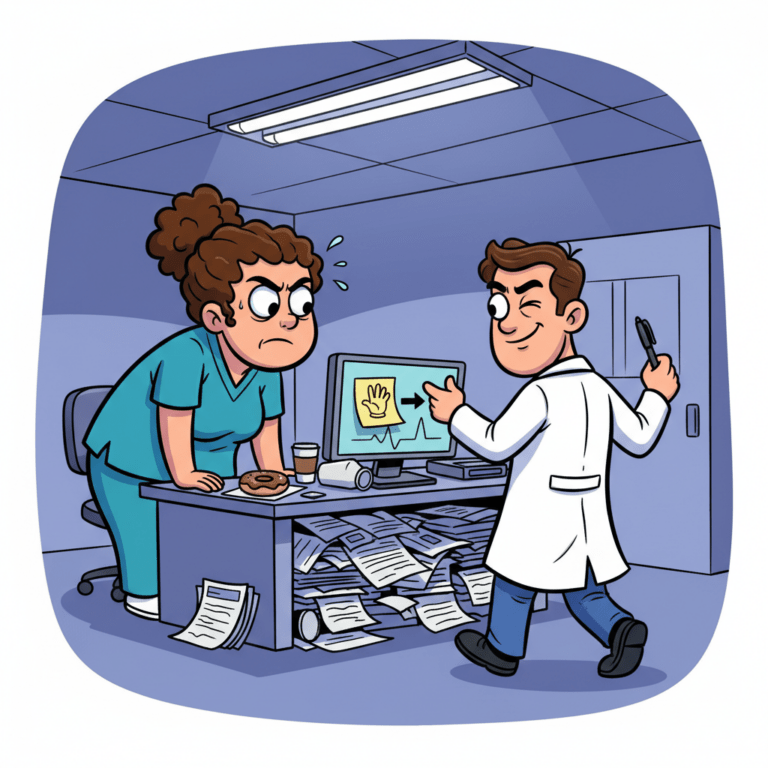
4. The “Excuse Me, Nurse…” Whiplash
On your day off, you could sleep through a thunderstorm.
A lawnmower.
A delivery van reversing into a wall.
Possibly the apocalypse.
But let someone quietly whisper:
“Excuse me, nurse…”
and your eyes open instantly.
You are upright.
Fully operational.
Where am I?
What happened?
Who is deteriorating?
Why is somebody calling me?
Your brain has basically installed a special emergency notification system.
It has no unsubscribe button.
🔮 Part 2: Defying the Laws of Physics
5. The Pen-Seeking Divination
A missing pen is never simply lost.
It has entered another dimension.
You check the desk.
Nothing.
The medication trolley.
Nothing.
Your pocket.
Nothing.
Then you spot it.
In the hand of someone who looked directly at you ten minutes ago and said:
“No, I didn’t borrow your pen.”
You say nothing.
You simply retrieve it.
The ancient nursing law has been satisfied.
6. The ED Clairvoyance
There is a particular feeling that happens when the Emergency Department is about to call.
The phone hasn’t rung.
Nobody has said anything.
But somehow you know.
You look at your colleagues.
They look back.
Someone quietly says:
“We’re getting an admission, aren’t we?”
Nobody answers.
Because saying it out loud would make it real.
This one belongs firmly in the folklore department rather than the science department. Your brain is extremely good at noticing workload patterns, timing, staffing pressures and the general rhythm of a hospital.
It just occasionally packages all that information as:
“I have a bad feeling.”
7. The Bladder Time-Dilation
Nursing has somehow produced a completely fictional branch of human anatomy in which the bladder apparently becomes optional.
You can spend hours thinking:
I really need to go.
And then another call bell rings.
So you don’t.
Then another patient needs something.
Still don’t.
Then somebody asks for help transferring a patient.
Apparently your bladder has accepted the terms and conditions.
Your bladder is not a scheduling system.
Eventually, it will file a formal complaint.
8. The Blindfolded Scrub-Pocket Extraction
Your scrub pockets contain approximately 47 unrelated objects.
Flush.
Tape.
Gauze.
Alcohol wipe.
Pen.
Another pen.
Something you have no memory of acquiring.
Possibly a snack from 2019.
And yet your hand can go straight in and retrieve exactly what you need without looking.
It’s not magic.
It’s tactile memory.
Repetition.
Muscle memory.
And the deeply developed ability to operate a pocket like a small archaeological excavation site.
🎭 Part 3: The Dark Floor Psychology
9. The Lunar Chaos Matrix
You don’t need a calendar to know when there’s a full moon.
You can just look around the ward.
Three bizarre conversations.
Two confused patients.
A call bell that has somehow become a permanent sound effect.
Someone asking where they are while standing directly underneath the giant sign explaining where they are.
You look at the clock.
Then at your colleague.
“Full moon?”
Maybe.
But here’s the awkward scientific footnote:
The full moon does not appear to cause hospital chaos.
Research has repeatedly failed to find a reliable lunar effect on hospital admissions, emergency department volumes or psychiatric admissions.
So the moon is innocent.
Probably.
The ward, however, remains under investigation.
10. The Jinx-Dar: The Forbidden Q-Word
Your brain has classified the word:
Quiet
as a Class-A explosive.
If a new nurse says:
“Wow, it’s really quiet tonight.”
you don’t respond.
You simply stare at them.
They have made a terrible mistake.
The universe is now loading.
Three admissions.
Two falls.
A broken printer.
Someone demanding tea.
The phone ringing continuously.
And one mysterious piece of equipment making a noise nobody can identify.
There is no scientific evidence that saying the Q-word causes chaos.
But after enough shifts, you stop testing the theory.
11. The “I’m Fine” Translation Matrix
When a colleague says:
“I’m fine.”
during hour ten of a twelve-hour shift, your brain doesn’t necessarily believe the words.
It looks at everything else.
Their face.
Their posture.
How quickly they’re speaking.
Whether they have eaten.
Whether they’ve gone unusually quiet.
And, crucially, how aggressively they just closed the medication cupboard.
Sometimes they need:
Chocolate.
Sometimes they need:
Two minutes in the clean utility room.
Sometimes they need:
Someone to say, “Go. I’ll cover you.”
And sometimes they genuinely want to be left alone.
The skill isn’t mind-reading.
It’s noticing.
🩸 Part 4: The Physical Mutation
12. The Smell-to-Diagnosis Myth
Every experienced nurse knows that hospitals have smells.
Some are unmistakable.
Some make you immediately suspicious.
And yes, experienced clinicians can develop strong associations between certain odors and clinical situations.
But let’s retire the idea that nurses can reliably diagnose C. difficile, GI bleeding or Pseudomonas simply by sniffing the corridor like a medical bloodhound.
That’s funny.
It’s also not a diagnostic test.
Your nose may tell you:
“Something is definitely happening in that room.”
Your assessment still has to do the rest.
Because unfortunately, Florence Nightingale did not leave us a certified olfactory laboratory in the scrub pocket.
13. The Vein X-Ray Vision
You no longer see people’s arms normally.
You see vascular architecture.
Standing in a supermarket queue, your brain quietly notices somebody’s forearm and thinks:
Interesting.
Then immediately:
Stop looking at strangers’ veins.
It’s slightly creepy.
It’s also extremely difficult to switch off.
Years of clinical practice can make you very familiar with anatomy, landmarks and what makes a vein look promising or absolutely determined to ruin your afternoon.
You are no longer simply shopping.
You are conducting an involuntary vascular survey.
14. The Gravity-Defying Juggle
Four cups.
Three pill cups.
A basin.
A pillow.
A chart.
A phone.
A door.
No hands left.
So you open the door with your hip.
Move the trolley with your knee.
Balance the basin against your forearm.
And somehow nothing falls.
Nobody taught us this in nursing school.
They should have.
Forget the Krebs cycle.
This is the real curriculum.
15. The 06:45 AM Resurrection
At 6:30 AM, you are finished.
Not metaphorically.
Your soul has already left the building.
Your eyes burn.
Your back hurts.
Your brain is running on approximately 3% battery and one remaining thought:
Bed.
Then the day-shift nurse walks through the door.
Something happens.
Your posture changes.
Your voice becomes professional.
Your brain suddenly remembers every important detail from the last twelve hours.
You give a flawless handover.
You answer questions.
You remember the bloods.
The medications.
The overnight changes.
The patient who needs review.
You look, briefly, like a functioning adult.
Then you leave the building.
Twenty minutes later, sitting in your car, you are basically a Victorian ghost.
🖤 The Verdict
They call it experience.
We call it the survival instinct.
After enough shifts, your brain starts collecting tiny pieces of information without asking permission.
The sound of an alarm.
The rhythm of footsteps.
The expression on a patient’s face.
The silence before something happens.
The colleague who says “I’m fine” in a voice that absolutely does not mean fine.
Some of this is clinical experience.
Some is pattern recognition.
Some of what you notice is also shaped by fatigue.
And some is just nursing folklore passed from one exhausted vampire to the next.
But that’s the strange thing about doing this work for long enough.
You don’t necessarily become less human.
You become hyper-aware of other humans.
You hear things.
You notice things.
You anticipate things.
And sometimes you know something feels wrong before you can quite explain why.
That doesn’t make you psychic.
It makes you experienced.
And occasionally extremely tired.
So drink some water.
Wash your scrubs.
Go home.
And for the love of God:
don’t say the Q-word.
The moon has been scientifically cleared.
The ward has not.
Note: The Facebook Group is our temporary launch incubator. Our fully private custom platform is under construction right here on the website!